Returning the Self to the Centre

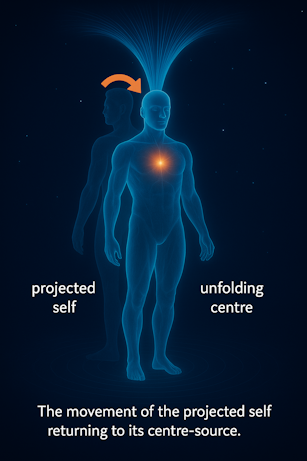
The self returns from projection to the quiet centre from which it first arose.

There is a point in this journey where thought can no longer carry us further. You begin to notice that every attempt to solve yourself with yourself only pulls you further from the quiet centre where all things begin. What you once trusted — analysis, effort, intention — starts to reveal its limitations. Not because it is wrong, but because it was never meant to take you all the way home. The mind fragments to understand, but the source does not live in fragments. It lives whole.

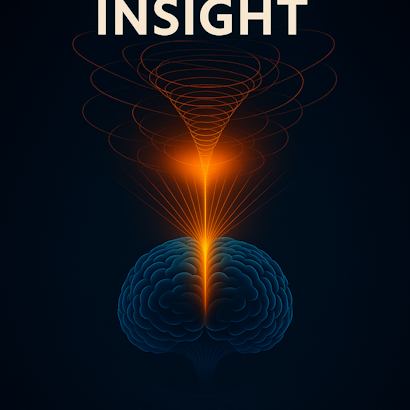
We start here because this is where it all begins: with the sense that nothing in us is useless, and nothing is to be denied. The self, even in its confusion, is not a mistake. It is only a movement outward from the source, stretched too far into thought and divided perception. And what stretches out can return. Insight is this return — the quiet flipping of the self back into the centre-source from which it first arose. It is a movement in the living mind.

When the self extends away from the centre, it tries to solve life from outside of life. Thought builds structures, opinions, and beliefs. It separates the world into pieces in order to understand it. In doing so, it loses the very thing it is seeking — wholeness. But when insight strikes, something else happens. The self does not continue outward. It turns, softly, like a leaf in still air, and falls back to where it came from. The centre. The source. The place beneath thought from which thought is born.

In this return, there is no violence. No rejection of the self. It is not destroyed. It is dissolved into its origin, like a wave receding into the sea. And here, something extraordinary becomes ordinary: the centre-source begins to respond. But it cannot respond when the self is loud, occupied, and constructing its own answers. The source does not interrupt. It waits. And only when the self becomes silent — truly silent — does the source begin to speak as insight.

This is why silence is not absence. It is communion. It is the doorway through which intelligence flows. People speak of no-self and mistake it for disappearance. But it is not about becoming nothing. It is about no longer standing between yourself and the source. The self bows. It returns to its birthplace. And in that returning, it becomes transparent. Life sees through it again.

We return to the simplest truth: nothing in us is useless. The self, thought, emotion, memory — none of it is an error. All of it arose from the same source. But when the self extends itself away from that centre, when it tries to operate without returning to where it was born, fragmentation appears. Thought begins to divide what in reality has never been divided. It creates questions and then tries to answer them from the same place they were created. This is why suffering loops. The self leaves the centre, tries to solve itself from outside its origin, and in doing so, multiplies distortion.

The mind fragments only to understand, but understanding can never be whole while it stands outside its own source. This is why every answer gained through thought alone eventually dissolves into another question. The self solves a problem only to create a new one beside it. It is not a failure — it is simply the nature of a self that has moved too far from the place of its birth. And yet, this movement outward has a purpose. It shows us the cost of distance. It leads us to the threshold where thought can go no further and something quieter must take over.

Insight does not come from effort. It appears when the self stops interfering. When the movement of thinking returns to silence, the source begins to see on our behalf. This is the turning point. The self does not disappear — but it bows. It softens back into what made it. Only then can the centre-source respond. How can the source solve what it has not been shown? How can it answer a question that has not been surrendered to it?

This is why silence is not absence — it is communication. It is the way the self returns to the origin and says, without words: here is what I cannot solve from the outside. And in that silence, the centre-source sees, understands, and responds — not with noise, not with argument, but with a single, quiet movement called insight.

At a certain point, the self begins to sense this. An understanding that no matter how refined thought becomes, it cannot touch the root of what is asking to be known. This is where the final turning begins. Not the rejection of the self, but its return. The self must be shown how to fall back into the place it first arose from, like a wave dissolving into the sea. This is what we call silence. Not passivity, not suppression, but the self no longer scattering itself across time. It rests. It waits. It listens.

This is how the source begins to answer — not through force, not through will, but through the quiet return of the self to where it came from. A question placed in silence is not ignored. It is received by the centre that birthed the self in the first place. And from that stillness, a response arrives — not as thought layered upon thought, but as insight. This is why silence is not the absence of self, but the alignment of self with its origin. Only in such alignment can the source respond clearly.

And it is from this point that the idea of no-self must be understood correctly. No-self is not the disappearance of who you are. It is the self no longer standing between you and the source. It is the self stepping back into silence so that the centre can see clearly. When teachers spoke of the end of self, they meant the end of resistance — not the end of being. The self remains, but it is clear, unburdened, and obedient to what moves through it. This is the centre of the transformation process of the self when it is in its source.

From here, the self does not vanish — it learns when to move and when to be still. It speaks only when called by insight and rests when silence is enough. This is not extinction; it is harmony. The self becomes an instrument rather than an interference, a window rather than a wall. And in that clarity, life begins to move as one whole, without the constant interruption of a self trying to manage what the centre already knows….

Yet even this transparency of self is not the end. It is the beginning of living from the centre. Thought still appears, but it no longer argues with life. It listens. Insight arises, but it is not separate from thinking — it moves through it. This is what it means when thinking and insight become one. The source does not erase the self; it uses it, gently, precisely, only when needed. And when it is no longer needed, the self falls silent again, without struggle.

From here, awakening is no longer an event but a way of being. Life does not become extraordinary; it becomes real. Simple acts — walking, speaking, resting — are no longer separate from the centre. There is no longer someone trying to live spiritually, and a world resisting it. There is only life moving from its origin without interference. Problems still arise, but they are brought back to the source, not spun into chaos by thought. The response comes, as it always has — quiet, accurate, kind.

This is the final step: not the disappearance of life, but the disappearance of distance. The centre is no longer visited in moments of clarity; it becomes the ground we never leave. And from here, the world is whole again — not because it has changed, but because we have stopped standing outside of it.

In this way, awakening is not a moment but a settlement. It is not a peak to hold, nor an experience to repeat, but the quiet recognition that the centre has always been here — waiting for the self to return. Life goes on. You speak, you work, you feel joy, you feel sorrow. But something fundamental has changed: you no longer leave the centre to live. The movement outward and the return inward are now one seamless gesture. Action and stillness are no longer opposites.

The world does not become perfect, but it becomes whole. Problems may still appear, yet they are no longer carried by the mind alone. They are brought to the source and answered there. And the answer does not always come as words — it may come as a shift in perception, a softening inside, a knowing without thought. This is the final step in understanding: insight is not something you make. It is something you meet.

So the journey that began with fragmentation ends in simplicity. Not because complexity has vanished, but because everything now rests on one foundation — the centre from which all things arise and to which all things return. Nothing is rejected. Nothing is outside the One thing. And in this wholeness, the self is free to appear and disappear without conflict. It is no longer the doer. It is the instrument of something deeper.

Here, the search ends — not in conclusion, but in clarity. Not in escape, but in arrival. And in the stillness of that arrival, life begins again — ordinary, luminous, indivisible.

This is where the journey ends and living begins. The centre is no longer something you return to — it is the place from which everything moves. There is no effort to stay here, no discipline to maintain it. The silence holds itself. Insight appears when needed, thought follows when called, and both rest when their work is done. Nothing is rejected, nothing is clung to. Life moves, and you move with it — not as someone seeking, but as the space in which seeking is no longer necessary.

And so, the self is not destroyed. It has simply remembered its place. It rises from the source and returns to it, like breath. This is the final step into awakening — not the disappearance of who you are, but the discovery of what you have always been. The one movement behind thinking, feeling, living. The centre-source that waits in silence for the self to come home. When this is seen, the search ends — not because there is nothing left to find, but because you are already standing at the place from which everything is found.

The transformation, then, is not the erasing of who we are, but the returning of the self to where it began. When the self stops trying to think its way out of life and falls back into the quiet of its own centre, something deeper begins to respond. Insight appears — not as a product of effort, but as the natural movement of the source seeing through us again. Thought does not create it; thought becomes still enough for it to arrive. And in that stillness, the self is not destroyed — it is realigned. It becomes transparent to the centre from which it came, and through that transparency, it is quietly transformed.
Return To Source
Self And Centre
Insight
Transformation Of Self

Related Images:

Finding Meaning in Thinking

The subtle shift from analysis to insight, from effort to unfolding.

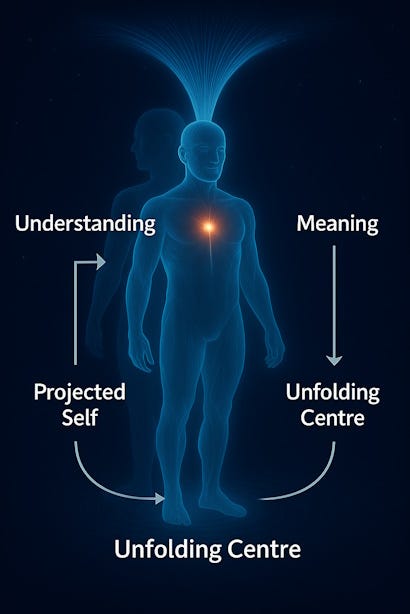
Self understanding and centre source in stillness gives it meaning — creating wholeness

There was a time when understanding seemed like the only path to truth. To live correctly, to make decisions without regret, one believed it was necessary to know everything, to gather knowledge from every corner of the universe and assemble it with thought until the truth finally appeared, whole and without doubt. But this pursuit was endless. Knowledge multiplied, thought compared and analysed, and the mind, exhausted, remained divided. Something was missing. Not more information, but another way of seeing.

Understanding, in the way we have always known it, is the movement of thought. It draws from memory, from experience, from inherited patterns. It moves horizontally — across time — placing one idea beside another, building explanations, solving through addition. Yet because it is built from fragments, it remains fragmentary. One part of the mind reaches a conclusion, another part questions it. Thought argues with itself. There is always another piece of knowledge, another perspective unseen. So understanding never arrives at finality; it remains in motion, unresolved.

Meaning is different. Meaning does not assemble itself from thought. It reveals itself when thought becomes quiet. It is a vertical movement, not a horizontal one. It is not constructed; it unfolds. When the mind is no longer reaching, when it stops trying to fix or complete the world, something opens from within — the centre, the source. Insight appears there. It does not come step by step. It comes all at once, whole, without argument. It is seen, not built.

This is why understanding belongs to time, while meaning belongs to the timeless. Understanding needs effort. Meaning needs silence. Understanding tries to solve. Meaning simply shows.

We separated these two movements deliberately — understanding and meaning — not to create opposition but to see each clearly. If they were spoken of together from the beginning, their distinction would blur. The mind would assume they are variations of the same process. They are not. One is thought grasping for truth. The other is truth arriving when thought lets go.

But now, to leave them separate would be incomplete. In life, they meet. They belong to one intelligence. Thought forms the question. Silence reveals the answer. Understanding shapes the vessel. Meaning fills it.

You can see this in the simplest acts of creation. In the painting studio, there is first struggle — the mind trying to arrange form, colour, proportion. Thought works, revises, doubts. If one keeps forcing through time, no resolution appears. But when the painter leaves the studio, rests, or wakes the next morning, the problem is resolved. Not by more thought, but by meaning quietly arriving in its place. Form becomes clear. The hand knows what to do. It is not magic. It is the rhythm of the mind returning to the centre.

The same happens when imagining a garden gallery — placing paintings among trees, combining cultivated form with wild nature. Thought begins the work: Where will the path go? How will light move across the canvas hanging between leaves? But insight is what completes it. One cannot think the whole into existence. At some point, the mind falls silent — naturally, without effort — and the arrangement appears inwardly, peaceful, whole. Understanding began it. Meaning completed it.

Press enter or click to view image in full size

Juxtaposing beauty of nature with doing

So neither is discarded. Nothing in the brain or mind is a mistake. Thought has its place. It builds, plans, names, and measures. Insight has its place. It sees, aligns, and reveals what thought cannot construct. They do not oppose each other when each remains in its rightful place. Conflict only begins when thought tries to do the work of insight, or insight is expected without the mind ever having looked, questioned, or cared.

In truth, they are like breathing. Understanding is the in-breath — the gathering, the shaping, the movement outward into form. Meaning is the out-breath — the returning inward, the release into the centre. Life requires both. Creation requires both.

This is the quiet climax: understanding is fragmentation seeking wholeness; meaning is wholeness answering. One reaches outward. The other unfolds inward. And when the two are no longer fighting, but moving together, the mind becomes a single, coherent field — capable of thought, capable of silence, capable of truth.

We explained them separately only so each could be seen clearly. But in truth, they arise from the same source. The centre does not belong only to meaning, and thought does not stand apart from it. Thought is the centre moving outward into form; meaning is the centre folding back into itself. They are not two origins, but two movements of one intelligence. When the mind sees this, understanding does not obstruct silence and silence does not reject form. They work as one rhythm — like breathing out and breathing in — each completing the other.

Two movements of one source

From here, decision and action no longer depend on the strain of accumulating certainty. They arise from a simpler order: the mind looks, thought explores what it can, and when it reaches its limit, it becomes still. In that stillness, meaning appears — not as a reward, but as a natural consequence of no resistance. This is not a technique. It cannot be forced. It happens the way dawn happens when the night stops resisting the light.

So the search is no longer a struggle to collect answers. It becomes a listening. Understanding listens outward into the world. Meaning listens inward into the centre. When these two listenings meet, the mind stands in the only place where clarity is possible — present, undivided, open.

From here, nothing is forced. Thought is free to move when it must; silence is free to return when it will. Action comes as a continuation of seeing. Life proceeds without the old friction of choosing between fragments. There is still work, effort, and uncertainty in the practical world, but inwardly, the ground is no longer divided. One knows what to do when one sees, and if one does not yet see, it is no longer a failure — it is only a signal to be quiet.

We began with the belief that to live without regret, one must understand everything. We end with a different understanding: one does not need to know everything. One needs to see clearly. And clear seeing is not the achievement of thought alone, nor the denial of thought, but the meeting of thought and silence in the centre where meaning unfolds.

In that meeting, understanding is no longer a burden, and meaning is no longer rare. They move together, like two currents of the same river — one shaping the banks, the other carrying the water. And the mind, no longer divided between effort and insight, becomes what it was always capable of being: a place where truth can be seen and lived without conflict.

It is the natural turning of the mind — from understanding as effort, to meaning as wholeness unfolding from the centre in silence.

Understanding And Meaning
Making Thinking Kosher
Sense Of Knowing

Related Images:

Insight – The Emergence of Meaning

Subtitle: Insight is the mind’s way of seeing meaning directly.

When thought is silent, the universe organises itself into understanding. This is insight.

Insight is not something the brain calculates or invents. It is not thought rearranging information. It is what happens when perception is allowed to move inward without interference and becomes understanding. Insight is perception completing its movement. It is intelligence in silence — where the mind is no longer grasping, comparing or projecting, but simply clear enough to receive what is already there.

Thought cannot produce insight. Thought is always old. It is made of memory, of what has been known and experienced before. It can modify, compare, analyse, and extend what it already knows, but it cannot step beyond itself. Insight is different. It arrives not through effort, but through stillness — when the mind is attentive without strain, and quiet without suppression.

Insight begins in the same place as perception. Perception sees what is. But where perception often stops at form, insight continues into meaning. It does not break experience into pieces in order to understand it. It meets it whole. It is not built by logic; it arrives as a direct seeing. That is why it feels sudden, effortless — like light revealing a landscape that was already there.

It may appear as though insight comes from nowhere. Yet it comes when the mind is no longer clouded by resistance, fear, or the need to defend an image of the self. When the surface of the mind is disturbed, like a rippled lake, what is reflected becomes fragmented. But when the surface becomes still, without force, the world reflects itself clearly. In that stillness, insight appears.

Insight carries no conflict because it is not divided. It does not argue with what is seen. It does not seek to change it, nor to protect the self from it. It is simply the direct meeting of truth. From that meeting, action is not chosen between alternatives; it flows naturally — without effort, without regret, without resistance. It is action in harmony with reality.

This movement of insight is similar to how nature creates form. A proton is not a solid object; it is a stable whirlpool in the quantum vacuum, a continuous inward and outward flow held in balance. A cell is a boundary where chemistry, water and information circulate and sustain life. In the same way, the brain is not merely a machine of thought. It is a place where reality can enter and be held — long enough for understanding to emerge.

When perception flows inward and is not stopped by the noise of thought, it reaches the silent core of awareness. There, instead of being captured by memory or bent by emotion, it organises itself into understanding. This is insight. It is not a conclusion; it is a revelation. It does not come from the past; it is born in the present.

Insight is the mind aligned with reality. Not reality as imagined or desired, but reality as it is. It is the universe touching awareness without distortion. It is what remains when the mind is quiet, alert, and free of resistance. In that quietness, intelligence is not personal. It does not belong to “me.” It simply operates — clear, compassionate and whole.

Such intelligence does not create inner conflict because it does not act out of fear or conditioning. It acts out of seeing. And when seeing is complete, action is complete. There is no residue of doubt, no division between the observer and the observed. There is only movement — like water flowing downhill, like light spreading into darkness.

Insight cannot be summoned. It cannot be manufactured by method or discipline. But the mind can become quiet, attentive, unburdened by the weight of thought. In that silence, insight comes naturally — like dawn after night, like breath after stillness. It is not an achievement. It is the natural flowering of a mind that has stopped interfering with what is true.

To live with insight is to live without inner contradiction. It is not a mystical state or a special gift. It is the most natural state of a human mind that is awake. Insight is not the end of thought — but the right place of thought. Thought becomes a tool, not a master. Silence becomes the ground, not the absence. And intelligence moves without conflict, because it moves with life, not against it.

In the end, insight is meaning arising from silence. Not the meaning we fabricate to feel safe, but the meaning that is revealed when the mind no longer interferes. After all the noise of thought and the chaos of interpretation, insight is the moment when perception touches truth and order appears. It does not create meaning — it sees it. And in that seeing, the mind is no longer in conflict. It understands. It moves with life, not against it. Insight, then, is not an answer — it is the quiet recognition of meaning already present in the fabric of what is.

Insight Meaning
Perception
Manifest What You Want

Related Images:

Perception — The Singularity Where Reality Becomes Experience

Here we stand, inside the universe — but also looking at it. What exactly is this act of seeing? Where is perception happening?

Perception is not something that happens inside the brain, nor is it a photograph of the outside world. It is a meeting point, a boundary where the world and awareness touch without fully becoming one another. At this boundary, something new appears — neither purely matter nor purely mind, but experience. Light does not become sight until it crosses this horizon. Sound does not become hearing until it enters awareness. Perception is this crossing.

It is often imagined that perception is a copy of the world stored inside the brain. But nothing is copied. There is no image inside the skull, no little screen on which reality is projected. What exists are electrical impulses, fields of activity, and flows of energy. Yet somehow, there is colour, texture, distance, sound, taste, pressure, warmth. These do not exist out there in the world, nor in the brain’s circuitry alone. They exist at the very point where the world and the brain meet and generate awareness.

Perception begins as raw information — photons striking the eye, air vibrating against the eardrum, molecules touching the nose or tongue, pressure forming on the skin. But perception itself is not in these signals. It appears only when those signals are shaped by attention, when they are gathered into coherence by the brain and allowed to touch silence within. It is not what enters the senses that matters — it is what crosses into awareness.

This is why perception feels so immediate, so intimate. It is not distant, like an idea about the world. It is the world arriving within. Yet perception is not fully the world, nor fully the self. It is a threshold — a singularity of experience. In physics, a singularity is a point where the usual rules break down, where something infinite touches something finite. Perception is like this. The infinite complexity of the world meets the finite structure of the brain, and out of that tension arises experience.

When the mind is agitated — filled with thought, memory, fear, projection — this horizon becomes clouded. Perception bends inward, shaped more by expectation than by reality. We do not see what is, but what the mind allows. It is like looking through water rippling in the wind. The world arrives broken, fragmentary. But when the mind becomes still, perception clears. Like a lake without wind, it reflects the world as it is, without distortion. In this stillness, there is no gap between the seer and the seen, the listener and the sound. There is only perception itself — effortless, precise, whole.

At such moments, perception feels less like something we do and more like something that happens through us. Awareness opens, and the world flows in. The boundary between inner and outer grows thin. The tree is simply seen, the sound is simply heard — without naming, without judgement. Thought may come later, but perception arrives first, pure and indivisible. It is the foundation of all knowing.

To understand perception in this way is to recognise its structure. It moves like a torus, like a vortex. Information flows inward — from the world into the senses, into the nervous system, into awareness. Then it flows outward again — as meaning, emotion, response, action. This is not a straight line from object to brain. It is a loop — a continuous circulation. Inward sensing, outward expression. World to awareness to world again.

This flow is not so different from what we see in nature elsewhere. A proton holds the vacuum in a stable vortex, creating mass. A galaxy spins around a centre, holding stars in motion. A cell holds chemistry in a membrane, creating life. The mind holds awareness at a boundary, creating experience. It is the same gesture across scales — the universe folding into form, and unfolding again into movement.

In this sense, perception is not passive. It is not a window. It is an active shaping of the world into knowable form. The world offers itself as a possibility; the mind offers structure. Between them, perception appears — alive, dynamic, changing every moment.

Insight is simply perception without interference. When the mind is quiet enough, reality enters directly, without distortion. It is not pulled into memory or pushed into analysis. It is seen. And in that seeing, something new can emerge — understanding, meaning, direction. Insight is not produced by thought. It arrives when thought steps aside.

This is why silence matters — not as absence of sound, but as absence of noise in the mind. In silence, awareness becomes like a clear lens. Perception sharpens. The event horizon of the mind becomes smooth. Reality flows in without resistance. And from that, meaning is born — not from effort, but from contact.

Perception, then, can be seen as a singularity — not because it is violent or destructive, but because it is where two infinities meet: the external infinity of the universe, and the internal infinity of awareness. Where they touch, experience appears. Where they dance, life becomes conscious. And where this touching is undisturbed, the universe recognises itself.

Perhaps this is all perception truly is — the universe folding itself into awareness through a human being. First as matter, then as life, and finally as experience. Not something owned, not something created by thought — but something happening now, in this very moment, as the world becomes conscious of itself through the quietness of a mind that is able to see.

Insights
Perception
Brain Mind

Related Images:

Cosmic Evolution from Proton to Planet

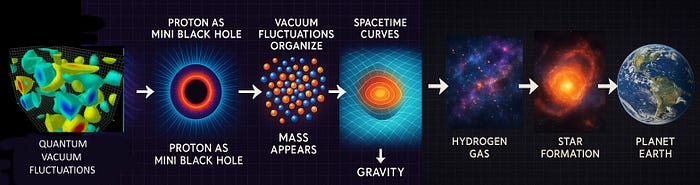
From the very first moment a proton emerged out of the quantum vacuum, the pathway to planets, stars and life was already seeded. This is not just a story of matter gathering in space, but of a single organising principle unfolding across scales — from the smallest stable structure in the universe to the birth of oceans and worlds. What follows is the journey of how a proton, a tiny vortex in the vacuum, became a planet beneath our feet.

In the very beginning, before stars, atoms or even space as we know it, there was only a sea of fluctuations — restless, silent, invisible. Physicists call this the quantum vacuum, but it is not empty. It trembles with possibility, full of tiny fields rising and falling, appearing and fading before they can ever become matter. From this neutral field, without shape or form, the first structure emerges: the proton.

This article traces the quiet unfolding of the universe — from the smallest unit of mass to the birth of worlds like our own. This is not a tale of explosions, but of gradual organisation. It is a story of how the vacuum learns to hold shape, how shape becomes gravity, how gravity gathers stars, and how from stars, planets like Earth are born.

1. Quantum Vacuum and the Birth of the Proton

Before there is matter, there is fluctuation. The quantum vacuum is a trembling field of uncertainty — particle-antiparticle pairs appearing and vanishing too quickly to be seen. In this field, nothing is truly still. It is a balanced ocean of energy, flat in geometry, containing no gravity, no curvature — only potential.

A proton is the first stable imprint on this canvas. Not a solid thing, but a tiny region where vacuum fluctuations stop cancelling out and begin to organise. Instead of dissolving back into nothing, the fluctuations fold inward, like water spiralling into a drain. In modern physics, this is sometimes described as a miniature black hole — so small it cannot collapse into destruction, or appear and disappear, but dense enough to hold form.

Here, mass appears for the first time — not as a property, but as an effect. Mass is simply the pressure difference between the vacuum outside and the organised energy within. The universe has taken its first breath of structure.

First, picture the vacuum not as blankness but as a restless ocean of micro‑eddies — quantum vacuum fluctuations. Nothing here sits still. Tiny quanta crest and vanish in femtoseconds, like ripples that never become waves. In this neutral sea, there is no gravity, no direction, only equilibrium. What breaks the symmetry is organisation.

Now narrow your focus to a point where those fluctuations synchronise, as if a thousand tiny ripples met in phase. The field stops being merely busy and becomes coherent. In Haramein’s language, this coherence deepens until the point satisfies the black‑hole condition for its scale: a micro‑well in the vacuum, the proton as a miniature black hole. It is not a collapsed star; it is a standing vortex, a stable sink for vacuum flow at femtometer dimensions. This is the first creation — a place where the vacuum’s energy is captured and recycled fast enough to persist.

What, then, is mass here? Do not think of mass as a lump added from the outside. Think of a pressure difference. Outside the proton, the vacuum pressure is slightly higher than inside the coherent well. The result is a continuous inward flow, like water pressing toward a drain. Confinement plus flow produces an effective mass density. Mass appears because the vacuum’s jitter is being held in a pattern. In this view, mass is organised vacuum energy.

The moment mass appears, geometry answers. Spacetime around the well deforms, dimpling toward the centre. Gravity is the name we give to that deformation and to the inward current that sustains it. Nothing needs to pull; curvature and flow are the same story told two ways. A free particle simply follows the easiest path through the dimple — what Einstein called a geodesic. Thus, a proton is not only a unit of mass but a unit of curvature.

Hold that picture and scale it outward by many orders of magnitude. A universe rich with such wells — protons — cannot remain evenly spread. The tiny curvatures superpose and, over time, the neutral sea begins to gather itself. Protons pair with electrons to make hydrogen; countless hydrogens form wisps of gas; wisps become clouds. Gravity is weak in a single proton, but across light‑years it is patient and decisive.

As clouds grow denser, they cool and fragment, then collapse. In the collapse, pressure and temperature rise until hydrogen nuclei fuse. A star is born. Fusion is the second great organiser: it cooks the simplest units into heavier ones — helium, carbon, oxygen, silicon, iron — each forged in the star’s core where heat and density overcome repulsion. When massive stars die, they explode, returning their newly minted elements to space at enormous speeds, seeding the next clouds with rock‑forming matter.

Around young stars, the enriched dust and gas flatten into a thin rotating disk. Inside the disk, the same logic repeats: tiny grains stick, grow into pebbles, then boulders, then mountain‑sized planetesimals. Collisions are frequent, but not chaotic; each impact sheds heat and momentum, allowing larger bodies to keep what they collect. In time, gravity rounds the largest clumps into protoplanets. Some remain rocky and close to the heat; others accrete thick atmospheres and become giants. Our Earth grew within such a disk, assembled from elements forged in earlier stars and bound by the same curvature that first appeared around a proton.

If you replay the film in reverse, everything returns to the same principle. Planets come from disks, disks from stellar births, stellar births from collapsing hydrogen, hydrogen from protons and electrons, and a proton from coherence in the vacuum. At each step, the universe does not add substance from elsewhere; it organises what is already present. The vacuum becomes mass by patterning; mass becomes gravity by curvature; gravity becomes structure by persistence. Organisation, not addition, is the motor of creation.

A few practical images help the mind hold this:

• Quantum vacuum fluctuations: imagine a 3‑D mist of flickers, like bioluminescent plankton in a dark sea, flashing on and off with no net drift. • Proton formation: those flickers lock phase into a tiny whirlpool — an energy well at the femtometer scale — where inflow equals outflow, so the pattern endures. • Mass: feel the slight pressure difference between the restless outside and the ordered inside; the pattern’s persistence is what we measure as mass. • Gravity: watch the grid around the well relax into a dimple; nearby paths bend toward it without any rope or hook. • Cosmic structure: replicate the dimple trillions upon trillions of times; small bends add to larger valleys; rivers of hydrogen roll downhill into stars; stars fuse elements; their ashes settle into worlds.

Seen this way, the proton is not an isolated curiosity but the seed‑logic of the cosmos. It is the first successful negotiation between the vacuum’s infinite potential and the universe’s desire for lasting form. From that negotiation, everything else proceeds: clouds, stars, disks, planets — and at last the thin film of oceans and air where awareness can ask how it all began.

From Planet to Life

By the time a planet like Earth emerges, the universe has already rehearsed billions of years of transformation. Yet the story does not pause at the rock and atmosphere. The same organising principle that drew vacuum into a proton, hydrogen into stars, and dust into planets continues here — more subtle, slower, but no less exact. Now the stage is planetary, and the actors are water, carbon, atmosphere, light, and time.

Where does life begin? Not in chaos, but in gradients. Life requires imbalance — heat against cold, light against dark, ocean against crust. A young rocky planet spins beneath a star, bathed unevenly by radiation. Some regions scorch; others freeze. Between them arises flow — winds, tides, currents. Energy moves. And wherever energy moves across a difference, work becomes possible.

Consider Earth in its earliest stable form. Heavy elements like iron and nickel, forged in supernovae long before the Sun existed, have sunk to form a molten core. That core spins, generating a magnetic field — a shield against solar wind. Above it sits a mantle in slow convection, and above that, a fresh crust. Volcanoes exhale water vapor, carbon dioxide, nitrogen, sulfur. Comets and asteroids deliver more water and organic molecules. The sky thickens with steam and greenhouse gases. Rain falls for the first time.

Rain does not just wet the surface — it shapes it. It fills basins, dissolves minerals, and carries them to sea. Rivers form, carving paths that become channels for future life. In shallow oceans, a quiet miracle unfolds: water remains liquid. Liquid water is the universe’s great mediator — it softens extremes, dissolves solids, transports ions, stores heat, and allows molecules to meet and react without shattering. In liquid water, complexity does not simply survive — it accumulates.

Now imagine the ocean not as a vast, uniform soup, but as a mosaic of micro-environments. Deep-sea vents spew mineral-rich heat into cold water, creating colossal differences in temperature and chemistry. Sunlit shallows warm during the day and cool at night, concentrating and diluting salts in rhythm. Clays and mineral surfaces act as natural laboratories, holding molecules in place long enough for patterns to form. Carbon, oxygen, nitrogen, hydrogen, sulfur, phosphorus — ashes of dead stars — begin to assemble into chains.

These chains wriggle, fold, and attract other molecules. Some store energy, some catalyse reactions, some form membranes around themselves. None of this happens all at once, or by design. Like the proton, life does not arrive fully formed; it stabilises as a pattern first. It is not a thing — it is a dynamic arrangement of flow, energy, and boundary. The first cells are not inventions but solutions: membranes that hold water inside, keep chaos out, and allow just enough exchange to survive.

Why here? Why Earth? Because Earth offered three gifts rarely found together: liquid water, stable sunlight, and time. Its orbit is neither too close nor too far from the star that warms it. Its rotation creates cycles of light and dark, heat and cool — tempo for chemistry. Its size is large enough to hold an atmosphere but not so large as to crush its crust. Its magnetic shield deflects harmful radiation but lets light through. Its Moon stabilises its tilt, making seasons gentle rather than catastrophic. It is not perfect — but it is stable enough for the pattern to deepen.

In time, the chemistry learns to copy itself. Molecules become information. Information becomes memory. Memory becomes evolution. Cells learn to use sunlight directly — photosynthesis — releasing oxygen into the air. The sky, once orange and toxic, turns blue. Oxygen reacts with everything; it burns iron into rust, fuels metabolism, and makes complex life possible. The planet, once a ball of rock and fire, becomes a biosphere — stone, water, air, and life woven into one continuous process.

And still, the thread remains the same: the universe organises its own potential. The vacuum organises into mass. Mass organises into gravity. Gravity organises matter into stars and worlds. Worlds organise energy into chemistry. Chemistry organises into life. Life organises into awareness. The pattern does not break; it refines. Each step is built upon the last, but none are separate. To understand a leaf, one must understand the star; to understand the star, one must understand the proton. And to understand the proton, one must listen to the quiet trembling of the vacuum itself.

Earth, in its early form, was not yet the blue world of oceans and clouds. It was molten, unshielded, bombarded by asteroids, with volcanoes breathing gases into a forming sky. But even in this chaos, order was quietly setting its conditions. The planet cooled. A crust formed. Steam from countless eruptions condensed into clouds and fell back as rain — not for a day or a year, but for millions of years. Slowly, depressions in the crust filled with water. Oceans — a planetary mirror — appeared.

Water is not just a solvent; it is an organiser. It dissolves minerals, moves heat, transports ions, and softens the rigid into the possible. It allows atoms to drift, meet, and bind — not by force, but by opportunity. Underwater, near volcanic vents, minerals rich in iron, sulfur, and carbon formed honeycomb-like structures. These porous rocks behaved like natural laboratories, concentrating molecules, cycling heat, and providing gradients in temperature and chemistry — exactly the kind of gradients that make complexity more likely than randomness.

The Earth also developed a magnetic field as its iron core rotated. This field bent solar winds and cosmic particles away, preventing the atmosphere from being stripped. That atmosphere — mostly hydrogen, methane, ammonia, nitrogen, carbon dioxide, and water vapour — interacted with lightning and ultraviolet light to form more complex molecules: amino acids, lipids, and simple sugars. These did not appear as isolated miracles, but as repetitive patterns. Wherever energy met chemistry under stable cycles, matter learned to remember its shape.

In shallow pools, tides driven by the Moon’s pull repeatedly concentrated and dried these primitive molecules. Fatty acids aligned into tiny spheres — protocells — because water pushed them into that shape. Inside some of these spheres, strands formed — chains of nucleotides capable of storing order. These were not yet alive, but they could copy parts of themselves, sometimes with small errors. Error is not failure; it is evolution’s opening.

With time, some of these molecular assemblies achieved a loop: they could use energy from their surroundings to repair themselves, grow, and divide. This was the first metabolism. Life did not begin as competition; it began as persistence. To persist in a universe of change is to become a pattern that can remake itself.

This pattern — life — did not break from cosmic law. It extended it. Just as a proton organises the vacuum into mass, life organises matter into memory. It holds form against the pull of entropy by continuously inviting energy in, using it not to stay still but to stay becoming.

From there, the river of time widened — cells learned to photosynthesise, releasing oxygen and transforming the atmosphere; continents drifted; ecosystems formed; perception emerged; and eventually matter began to ask about its origins through the brain of a human being.

Seen in this way, life is not an interruption in the universe; it is its continuation. It is the vacuum learning to see through the eye of a creature on a small blue planet that was once a cloud of hydrogen, once a proton, once a fluctuation in a silent sea.

Oceans did not arrive in silence. They arrived with lightning, meteor impacts, volcanic gases and ultraviolet light striking the young atmosphere. Carbon dioxide, water vapour, methane and nitrogen swirled together under heat and electric storms. In this restless chemistry, simple molecules linked into more complex ones — amino acids, nucleotides, sugars. Not all survived; most broke apart. But a few, protected in shallow pools, clay surfaces or deep‑sea vents, endured long enough to meet others and try again. Life did not appear in a single spark; it accumulated through repetition.

Hydrothermal vents on the ocean floor offered a quieter stage. Here, superheated water rich in minerals met cold seawater. Iron, sulfur, and trace metals formed natural chimneys — porous, honeycombed structures. Inside their micro‑chambers, gradients of heat and chemistry mimicked the proton gradients that power cells today. Warm alkaline fluids flowed through, carrying carbon molecules. These molecules encountered surfaces that held them in place instead of letting them drift apart. Structure preceded function. Pores became reactors.

From this patient assembly, molecules began to cycle rather than scatter. Fatty acids clustered into spheres — primitive membranes. Within these spheres, chemical reactions could occur in isolation, protected from the vastness outside. Some configurations were reproduced imperfectly. Others fell apart. Time, as always, kept only what could persist. This is not separate from physics; it is physics becoming memory.

What we later called a cell was, at first, only a boundary holding pattern — a bubble that could harvest energy, maintain internal chemistry, and repair itself. Protons flowed across its thin membrane, driving the first metabolic cycles, echoing the ancient vacuum flow into the first proton. The same principle repeated on a new scale: a difference in pressure, a gradient, a flow harnessed to build and sustain order from the surrounding chaos.

From here, biology unfolds not as an exception to cosmic evolution, but as its continuation. Molecules become networks. Networks become protocells. Protocells become bacteria whose descendants will one day breathe oxygen, build coral reefs, and think. But the thread is unbroken. The logic remains: fluctuation to pattern, pattern to structure, structure to persistence. The vacuum organises into mass; mass curves into gravity; gravity gathers into stars; stars forge elements; elements collect into planets; planets host water; water becomes life; life begins to know itself. Each step is the universe folding into greater complexity to hold the same silent origin at its core.

Conclusion

From the smallest whirl in the vacuum to the first cell dividing in an ancient sea, the universe never changed its method — only its scale. A proton held the vacuum in pattern; a planet held fire and water in balance; a cell held memory and boundary within a thin film of chemistry. What began as a single vibration folded into form became the architecture of stars, the cradle of oceans, the quiet pulse of life.

From the proton to the planet, from the cell to the stars, the architecture remains the same — only the canvas widens. The same pattern that shapes a proton, a tiny well in the quantum vacuum drawing energy into a spinning vortex, appears again in galaxies, in magnetic fields, in the very structure of the cosmos. This is the holographic principle made visible: information is stored on the boundary, while flow moves through the centre in a double-torus rhythm — falling inward, rising outward, never static. The proton is the smallest stable expression of this geometry; the universe is the largest — The Holographic Principle.

Matter did not arrive from elsewhere — it learned to organise itself. Vacuum into mass. Mass into gravity. Gravity into stars. Stars into worlds. Worlds into life. And life, eventually, into awareness that can look back and recognise the pattern. To understand a single proton is to glimpse the blueprint of the whole. From silence, form can rise; from stillness, motion; and from the invisible, everything that can one day ask — “How did it begin?”

How Did It All Begin
Proton To Cosmos

Related Images:

Creation From the Centre

This article continues the exploration of how all movement, insight, and art arise from stillness — yet even before creation flows, there is a subtle contraction, the first stirring of self. This tension gives rise to intention, marking the delicate threshold between stillness and movement. Creation does not begin with thought but with this almost imperceptible shift before thought moves, when the self first leans toward expression and stillness begins to unfold into form. Now we will trace this process of creation, from its first stirring to its return to stillness, so that the reader can see how it begins and ends within the same unmoving centre.

There is a moment before a word forms, a moment before a brushstroke begins, a moment before a decision takes shape.

In that moment, a subtle stirring appears — a quiet tension, the self leaning forward to act. It is the first contraction, the spark that gives form its beginning.

If it is seen and not followed, the tension releases back into stillness. And from that stillness, creation unfolds by itself.

Not as expression of a self, but as movement of life.

The painter does not paint. The painting happens.

The speaker does not speak. The words happen.

The composer does not compose. The music arrives.

The centre does not push. It does not try. It does not choose.

It simply does not move. And because it does not move, what arises from it is free. It is an unfolding from the centre.

When Creation Comes From the Self

Most creation in the world does not arise from the centre. It arises from the contraction — the first movement of self.

The mind leans. It reaches toward an idea of what should be. It recalls what has been admired. It compares. It measures. It tries to become something through what it creates.

This is creation as identity.

The painter paints to be a painter. The writer writes to be understood. The speaker speaks to be respected. The thinker thinks to be right.

The act is no longer the expression. The act becomes the self.

The movement is subtle. It begins before the brush touches the canvas. Before the sentence forms. Before the first thought appears.

A quiet contraction. A tightening. A leaning forward.

This is the self making itself.

And creation becomes effort.

Not the effort of the body. But the effort of maintaining an image. A role. A name.

The work may still be skilful. It may be admired. It may even succeed.

But it carries the weight of the one who made it. You can feel the strain. The intention. The wanting.

It does not flow. It pushes.

It is not whole. It is constructed.

And when it is finished, there is always something missing.

Because what was being pursued was never the creation.

It was the self.

When the Lean Stops

There is a moment in creation where something changes. It is not dramatic. It does not announce itself.

The mind simply stops moving toward.

The reaching pauses. The tightening softens. The identity that was forming around the act fades.

There is no decision to stop. No discipline. No technique.

The movement that creates the self is simply seen. And in being seen, it no longer continues.

There is no collapse. No effort to return to stillness.

The centre is revealed as what has been here all along.

And creation begins to arise from silence. Not as expression of a person, but as the natural unfolding of life itself.

The hand moves without intention. The words form without a speaker. The gesture happens without a doer.

There is action, but no one acting.

There is creation, but no creator.

The centre remains still, and creation flows out of it like water.

Creation as the Universe Expressing Itself

When the contraction ends, what remains is openness. And from this openness, creation moves again — not from the self, but through the self.

The universe is always moving. Not as chaos. Not as force. But as an endless unfolding.

Form arising. Form dissolving. Form returning.

You are within that movement. Your body is within it. Your breath is within it. Your thoughts are within it.

When the mind leans, the universe is filtered through identity. The movement becomes personal. It becomes “my idea,” “my work,” “my expression.”

The self stands in front of the stream. And the stream becomes effort.

But when the centre is still, the stream flows without interruption. There is no one shaping it. No one directing it. No one choosing how it should appear.

Creation becomes as natural as the way a tree grows. Or a wave forms. Or a bird moves through the air.

There is pattern. There is form. There is beauty.

But there is no maker.

This is why the greatest works of art, music, insight, and compassion feel inevitable. Not invented. Not manufactured. Not designed.

They feel like something that was always there, waiting for someone to be still enough to let it appear.

Creation from the centre is not self-expression. It is reality expressing itself in a form that includes you but does not begin with you.

Living From the Centre

When the cycle completes, creation does not stop — it simply continues without contraction.

When the centre remains still, life does not become passive. It becomes simple.

Action continues. Work continues. Speech continues. Relationship continues.

But without the self leaning into any of it.

A task is done because it is the next movement of life. Not because it makes you someone.

A sentence is spoken because it is what needs to be said. Not because it creates an image of you.

Decisions unfold quietly. Not through weighing and comparing, but through a kind of natural clarity that requires no thought.

You do not withdraw from the world. You do not transcend it. You participate fully.

But without friction. Without resistance. Without becoming.

The centre remains still. The world moves around it. Life expresses itself through it.

This is not a state to maintain. There is no discipline here. No vigilance. No technique.

When the self is not being constructed, Sehaj appears on its own.

Ease without effort. Movement without a mover. Speech without a speaker.

Creation without a creator.

The centre does nothing. And in that non-doing, life becomes whole.

Closing — The One Stroke

Creation begins with a single movement.

Not the movement of thought constructing meaning, not the movement of identity trying to prove itself, but the smallest shift of attention from stillness into expression.

This first gesture is the only moment where intention appears.

After that:

the doer steps aside, the self dissolves into background, and creation unfolds on its own.

The brush moves, the hand responds, form reveals itself.

There is no plan. There is no controller. There is no one choosing the next stroke.

The centre creates through the body the way the wind moves through reeds.

The movement is not yours. It never was.

You were simply here when the universe needed a place to express itself.

This is why the masters always said:

“I do nothing. It is done.”

This is why the artist who creates from the centre does not feel pride.

This is why the musician who plays from silence does not feel ownership.

This is why the poet who writes from stillness reads their own words and recognises them as something they did not invent.

The centre is the source. The self is only the doorway.

When the doorway is not defended, not tightened, not claimed —

creation flows freely.

This is the art of the universe making itself visible.

Not through someone.

Through stillness.

Through the centre that does not move, even while the world dances around it.

There is nothing left to add.

Let the reader stop here.

Let the centre speak for itself.

This is why the masters said:

  • “I do nothing. It is done.” — Jesus
  • “No-mind is the highest art.” — Zen
  • “Sehaj is acting without acting.” — Guru Nanak
  • “The observer ends, and action is whole.” — Krishnamurti

They were all pointing to the same mechanism:

Action does not require a self.

Only identity requires a self.

Action is natural.
Becoming is artificial.

Creativity
Process Creativity Mind

Related Images:

The Bridge of Entanglement: From Quantum Teleportation to Human Insight

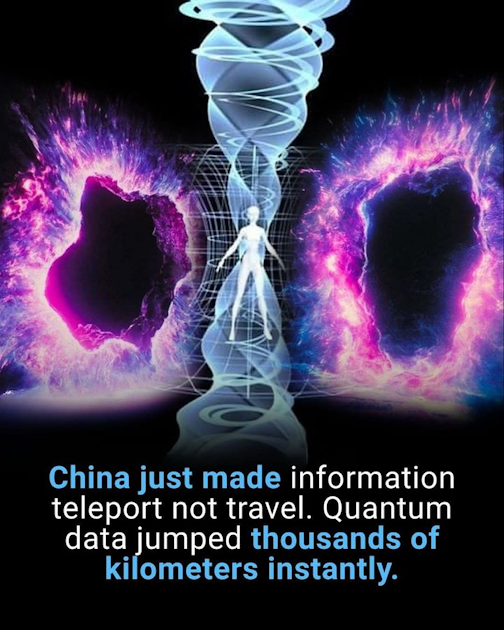
When Chinese researchers announced they had achieved quantum teleportation of information across fibre networks stretching thousands of kilometres, the scientific world paused. Quantum data had leapt between points in space without moving through it — a feat Einstein once called “spooky action at a distance.”
Credit: University of Science and Technology of China | Nature Photonics | MIT Technology Review.

We began our enquiry from this moment — a scientific milestone that seemed to bend not only our understanding of physics but also of consciousness itself. The experiment showed that information could appear elsewhere instantly, without traversing the space between. No signal, no carrier, no time delay. And yet, something profoundly real occurred: two particles, light-years apart in potential, responded as one.

In the language of physics, the entangled particles are not separate at all. They are expressions of a single, continuous wave function.

The Two Reflections of Reality

For entanglement to exist, there must be two matching states — one in the creator field (quantum space) and one in the created field (spacetime). The quantum field holds the pattern in potential, while spacetime manifests that pattern in tangible form. These twin reflections allow coherence to arise across the boundary condition: the proton or particle in spacetime mirrors its counterpart in the quantum field. Entanglement, then, is not a signal but a perfect symmetry that unites both sides of creation — the unseen and the seen, the potential and the realised. This same principle explains how insight arises within us, as the inner realisation mirrors the outer manifestation through the singularity.

In this way, what physics calls coherence becomes, in consciousness, understanding. The bridge is the same — a union between two matching realities. The outer and the inner, the particle and the thought, meet at the zero point, where distance dissolves and knowing becomes instantaneous.

Now, if we shift the lens inward, we find a mirror. What if insight — those flashes of sudden knowing — arise through the same principle? In the diagram of mind and singularity, awareness operates like a boundary condition, the human equivalent of a quantum field. At the still centre of the mind, beyond the chatter of thought, coherence forms. The brain does not transmit or receive; it tunes itself to the universal field where knowing already exists. Insight appears instantly, as if teleported from a non-local source.

This is not mystical speculation alone. Rupert Sheldrake once proposed the idea of a morphogenetic field within spacetime — a collective memory of forms, behaviours, and understandings. Each living system, he said, draws from and contributes to this field through resonance. In light of quantum discoveries, Sheldrake’s intuition finds a new context: the morphic field may be the biological manifestation of the same non-local coherence that underlies entanglement.

The singularity within us — what we call the centre source — acts as a point of contact with this field. When the mind becomes silent, it aligns with the singularity, and communication shifts from data transfer to field tuning. Knowledge does not travel; it emerges whole. This is living off the centre source, where awareness synchronises directly with the intelligence of the universe.

Imagine education, communication, and creativity in such a framework. Instead of transmitting information through language and time, we would learn by resonance — each mind becoming a coherent node in a planetary field of understanding. Just as entangled photons leap across space without travel, ideas, insight, and comprehension would arise instantaneously within an interconnected human network.

If I told you now that the future internet would not run only through cables and code but through us, would you believe it? Perhaps not — yet when the technology arrives, and the interface is the mind itself, we may look back and say it was always inevitable. The seeds are already here: quantum entanglement showing non-local coherence, neural networks mirroring collective patterning, and human awareness learning to tune rather than transmit. In hindsight, it will seem obvious that the true infrastructure of connection was biological and conscious all along, waiting for coherence to make it visible.

Science has shown us that entanglement breaks the limits of locality. Spiritual inquiry reveals that insight does the same within consciousness. Between these two, the bridge of understanding grows luminous: the universe and the human mind are both structured to know through coherence, not through distance.

Perhaps the next evolution of communication — and of humanity — will not be built on speed, but on stillness.

In the silence between thought and field, the universe listens.
Through coherence, it speaks back as knowing.

Quantum Consciousness
Living From The Centre
Fieldtuning
Morphogenetic Field

Related Images:

When the Ending No Longer Begins Again

The diagram contrasts the circular movement of thought within the extended self with the still point of awareness at the centre — where the loop of becoming resolves into being. How awareness collapses the loop of becoming into wholeness.

There is a moment when thought stops turning upon itself and begins to dissolve into silence. It is the moment when the mind ceases to seek meaning through comparison and returns to the source of perception itself. This diagram captures that shift — from living identified with the extended self to living from the centre.

When we live through the extended self, the mind is constantly translating experience into concepts. It divides the field of reality into the objective and the subjective — the thinker and the thought, the observer and the observed. This dualistic movement keeps the brain active in an endless loop of reasoning, where every conclusion becomes the premise for a new question. The beginning becomes the ending, and the ending is once again the beginning. Thought continues to orbit itself, always chasing clarity, never touching stillness.

In this state, we live through mental constructs — reflections of reality rather than reality itself. The mind believes that understanding will end the search, but understanding itself becomes another construct. The circle never closes because the self remains the reference point of all meaning.

Living from the centre ends this cycle. Here, awareness is no longer divided into subject and object. It is not the observer looking at life — it is life, perceiving from within. In this state, the thinking mind relaxes into coherence. The end of thought does not bring confusion but order — a natural alignment between the brain, mind, and the intelligence of the whole. There is no conflict, no resistance, no need for another beginning.

To live from the centre is to perceive directly, without mediation. The mind is no longer a commentator but a silent participant in creation. The dual motion of becoming collapses into being, and the loop of ‘ending as beginning’ naturally ceases. What unfolds from the centre has no opposite, no return. It is timeless awareness in motion — the universe perceiving itself through you.
The beginning ceases when the centre becomes the only movement of being.

Beginning And Ending
Ending Of Time In Mind
Unfolding From The Centre

Related Images:

The Forbidden Centre: Why We Are Not Meant to Know the Source

Living at the edge of the unknowable.

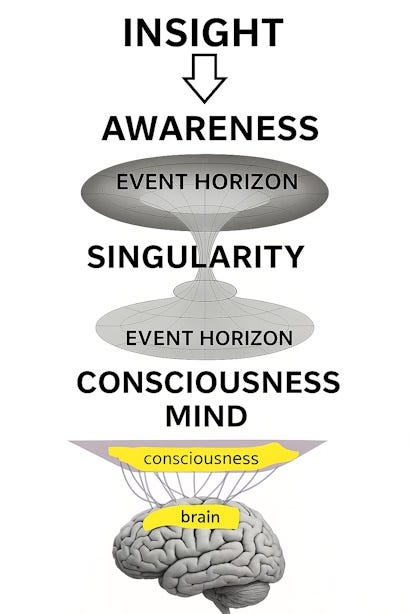
There is a reason the Source cannot be known. Not because it hides, but because its nature forbids observation. The closer awareness moves toward the origin of creation, the more it dissolves into the very stillness it seeks. Just as light cannot escape the gravity of a black hole, consciousness cannot cross the event horizon of its own being.

In the architecture of existence, both the universe and the mind mirror the same form: a double torus, a continuous in-and-out flow through a silent singularity. The brain sits at the visible edge of this geometry, translating the cosmic exchange into thought, perception, and language. Above it, consciousness expands as a living field, sustained by the invisible pulse of the singularity — Brahman itself.

When the mind falls silent, awareness descends toward that horizon. In deep sleep or in those rare creative silences when thinking stops entirely, the system folds inward. The mechanical mind disappears. Awareness reaches the black edge of knowing and pauses there, suspended between existence and non-existence. What lies beyond is not darkness but infinite density — the field of unmanifested potential. Yet, by design, we cannot enter it consciously. If the mind could observe the Source directly, it would interfere with the balance of creation, altering the very order that allows existence to unfold.

This is why Brahman remains untouched — not as an act of concealment but as a safeguard of coherence. The entire universe depends on this asymmetry between the knower and the known. Insight flows from the horizon back into the brain as light returns from the threshold — transformed, encoded, yet never revealing the essence of the silence from which it emerged.

The double-torus form shows us that awareness and silence are not opposites but complementary currents of one continuous flow. Insight is the bridge — the moment where the unobservable Source communicates with the finite mind without ever being seen. This is why true inspiration feels as if it comes from nowhere. It is the whisper of Brahman, translated at the edge of our event horizon.

To live consciously on the event horizon is to stand at the threshold of the unknowable, awake within the flow between silence and expression. It is to sense the infinite pressure of the Source without collapsing into it, to allow insight to rise without claiming ownership of it. The enlightened state is not a passage into the singularity, but the balanced awareness that the singularity is already expressing through us.

At this edge, there is no more search for union, because separation never truly existed. The brain becomes a mirror — a resonant surface through which consciousness translates the subtle oscillations of the universe into thought, art, and understanding. Every insight is a particle of the Source revealed in form, and every silence is the Source returning to itself.

We are designed not to know Brahman directly because knowing would collapse the wave of creation into a single point. Instead, we live as its holographic expressions, tracing the outlines of infinity through experience. Awareness becomes the moving surface of the eternal — the horizon where time and timelessness meet, where the universe breathes through us, and we, in turn, breathe it into being.

We are designed not to know the Source because knowing would collapse creation itself — enlightenment is learning to live consciously on the horizon of the infinite.

Living On The Edge
Of The Unknowable
Insight
Awareness

Related Images:

The Illusion of Nothingness: Why the Centre Is Never Empty

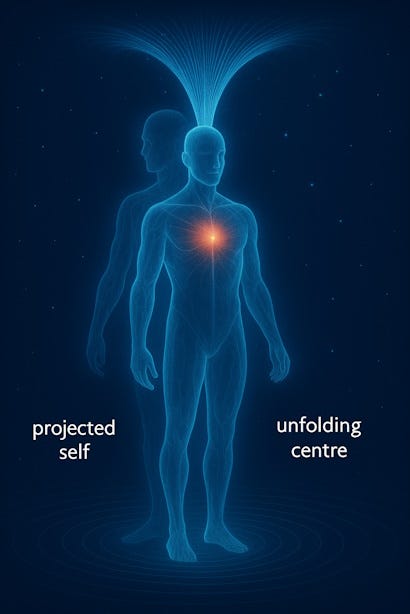
Self, projecting off its centre. Enlightenment, when projected self dissolves into its centre. These are 2 different realities in us. True freedom begins when perception withdraws from the projected self and returns to the centre, where stillness and creation move as one.

In recent years, a new language of spirituality has spread across the West, echoing through social media, self‑help circles, and even the quiet spaces of therapy rooms. Among its most repeated mantras is the phrase: “You are nothing.” For many, it has become the modern equivalent of enlightenment — a slogan of transcendence that promises freedom from anxiety, identity, and the endless chatter of the mind. Yet the phrase carries a hidden confusion. When people say they have become nothing, what they usually mean is that their external self — the image they have built through thought, habit, and comparison — has temporarily quietened down. What remains is a silence that feels vast, relieving, and free of burden. But this state, though peaceful, is not the end of the journey.

Nothingness, in the Western mind, has come to mean the absence of thought, the blankness that follows when the noise subsides. It is experienced as a relief because the self that constantly seeks validation finally falls silent. Yet the absence of noise is not the discovery of truth. It is only the clearing of the field. Real stillness is not a void but a presence — an alive awareness that continues to move even when the thinking mind has stopped projecting itself. The moment the self dissolves, what emerges is not nothing but everything: the effortless unfolding of life from its own centre.

The idea that enlightenment is nothingness comes from mistaking quiet for completion. True awakening is not the end of experience but its beginning in purity. When the outer self falls away and dissolves into the centre, awareness does not collapse into a vacuum; it opens into fullness with movement now off the centre itself and not of the projected self. The centre of being is never empty — it is dynamically alive, creative, and self‑sustaining and unfolding all the time, just not off the projected self anymore. To call it nothing is to describe it from the outside, from the perspective of what has dissolved. From within, it is everything happening at once, without effort or separation.

So while the modern phrase “you are nothing” may hint at humility, it also hides a subtle error. You are not ever nothing; you are no longer merely the self. What remains is not an absence but a vast presence — the living silence from which thought, love, and creation continue to arise. True enlightenment is not the extinction of being, but the revelation that being itself was never divided in the first place.

Clarification itself carries power, for it is not a passive act of understanding but a living revelation. When something becomes clear, the mind does not simply grasp an idea — it witnesses the centre revealing itself. In that instant of recognition, the movement of awareness is seen as self‑luminous, a quiet yet active unfolding. Clarity is thus the bridge between silence and expression, showing that the true nature of the centre is never inert. It is busy in its stillness, endlessly unfolding through the light of its own understanding.

Related Images: