
Recognising the Order That Is Already There
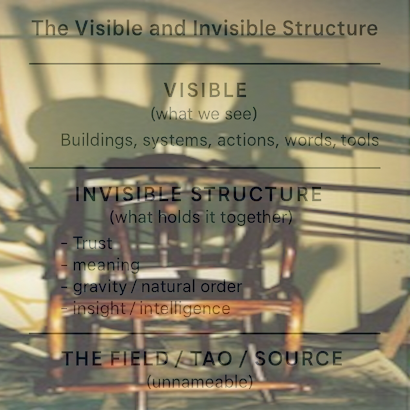
Thirty spokes meet at the hub of a wheel, but it is the empty space in the centre that makes it turn. Clay is shaped into a pot, but it is the hollow that makes it useful. Rooms are made by walls, yet it is the open space within that makes them livable. What is present gives form, but what is absent gives function. This is not poetry. It is a description of how reality works. Form is visible, but what makes form meaningful is invisible.
We live inside invisible structures every day. Gravity holds us to the Earth, yet it cannot be seen. A law holds a society together, yet it exists only because people agree to act as though it is real. Trust between two people cannot be touched, yet its absence can collapse a home. A city is built of roads and buildings, but it works only because of something unseen — unspoken agreements, restraint, courtesy, attention. Most of what makes life possible does not appear to the eye.
Modern living trains us to notice only what can be seen and measured. Education teaches the parts of a subject, not the field of meaning that holds the parts together. Work values output more than coherence. Technology accelerates surfaces. We become skilled at manipulating the visible and blind to the structures that make the visible function. The wheel still exists, but the hub is forgotten.
To exist in invisible structures is to recover the ability to sense what does not declare itself. It is practical. A musician hears not only the notes but the silence between them. A wise engineer senses pressure in a system before it breaks. A good judge knows when justice is being followed in form but betrayed in spirit. A true teacher does not force learning but creates the conditions for understanding to appear. The work happens in the visible world, but the guidance comes from what is invisible.
Invisible structures appear in many forms. Some belong to nature — gravity, magnetism, weather, and neural rhythms. Some belong to relationship — trust, fairness, responsibility, shared meaning. Others belong inwardly — intuition, attention, insight, the quiet knowledge of what is true before thought interferes. To live well inside these structures requires a different kind of intelligence — not the mind that imposes order, but the mind that listens for it.
This intelligence begins in stillness. As long as the mind is crowded with noise, the invisible cannot be felt. Insight appears when thought becomes quiet enough for something deeper to be seen. This is not inactivity. It is contact. The person who pauses and observes is not doing nothing — they are aligning with reality before moving. Movement that comes after alignment is simple and precise. Movement without alignment is friction.
Many of our systems are built as if the invisible did not exist. Cities grow outward with no centre. Schools deliver information without meaning. Markets expand without purpose. These are structures with walls but no interior space. They work, but they do not breathe. Repairing them does not begin with better tools. It begins by restoring a relationship with the unseen forces that hold life together — trust, proportion, rootedness, belonging.
To exist in invisible structures is not to abandon form. Roads must still be laid. Laws must still be written. Bridges, hospitals and poems still require craft. What changes is where they begin. When form grows from alignment with what is already ordered, it holds. When it is shaped only by will or profit, it cannot last. It floats above reality rather than growing from it.
We will never fully describe the source of this order. Call it Brahman, Tao, the Source, the uncreated — it lies beyond image. But we can sense its presence in a different way: as a quiet intelligence that appears when the mind is no longer projecting itself outward. Not as belief. Not as theory. As a simple recognition that order is already there, waiting to be aligned with.
To learn to exist in invisible structures is to let that recognition guide how we move. To step through the world without being blinded by surfaces. To speak while remaining rooted in silence. To build without forgetting the space around the form. To plan without breaking trust with what is true. It is to live as part of a deeper coherence rather than as the author of it.
The invisible order is present. Our task is not to invent it, but to notice it — and to let what we build, think and become take its place within it.
