
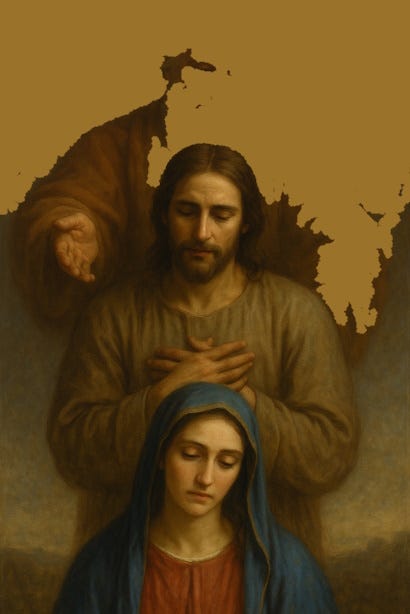
In light of the Vatican’s recent clarification that Mary is not co‑redeemer and that Jesus alone carries the act of redemption, it becomes meaningful to reflect on what redemption and surrender truly are. Not to argue doctrine, but to observe how insight moves — from Source, to those who receive it, to those who embody it. Insight does not arrive in isolation. It is passed, received, and surrendered into form. It does not belong to one mind, nor does it originate in thought. It moves like a quiet current through those who are willing, sometimes as a whisper, sometimes as a life.
(Catholics believe that Jesus redeemed humanity through his crucifixion and death, before rising again three days later.
Church scholars have debated for centuries whether Mary, who Catholics and many Christians call the Mother of God, helped Jesus to save the world.
The late Pope Francis fiercely opposed granting Mary the title of “co-redeemer”, and at one point called the idea “foolishness”.) Pope settles decades-long Catholic debate on role of Virgin Mary 5th Nov 2025
Mary’s story begins in silence. When the angel speaks, she does not reason or resist. She simply answers, “let it be”. In that moment, she becomes the first human vessel of surrender, not by understanding but by allowing. The intelligence that births form enters through her acceptance. She does not claim it; she receives it. From that, yes, the story of Jesus begins — not in a temple, not in a doctrine, but in the heart of a woman who stayed open.
Jesus is born from this first surrender, and yet his life becomes another kind of surrender. He carries what was given to Mary into the world, not as an idea but as a way of being. When he speaks, it is not his own authority he claims. When he heals, he says it is not himself but the Father working through him. And at the end, in the garden of Gethsemane, he returns to the same posture that began with his mother — “let it be”. Not my will, but Yours. What began in Mary now becomes complete in him. The intelligence that entered through her willingness leaves through his willingness, returning to its source.
This chain of surrender — Mary to Jesus, Jesus to the Creator — is not about hierarchy but flow. Insight moves from the infinite into form, and from form back into the infinite. None of them hold it. They allow it to pass through. Mary is not a co-creator in the sense of an equal Redeemer. She is the doorway. She receives. She nurtures. She advises. She lets the human and divine meet through love, not through power. Jesus is not separate from the Source. He is the embodiment of it. He does not claim it; he returns to it.
The Guru Granth Sahib begins in the same way. Not with a story, not with philosophy, but with a declaration of the Source itself: Ik Onkar. One Reality. Sat Naam, Truth is Its Name. Karta Purkh, the Creator Being. From that one utterance, everything unfolds. All hymns, all wisdom, all liberation — unfold from the recognition of the Creative Force. Just as Mary’s “let it be” opens the path for incarnation, the Mool Mantar opens the path for revelation. It is the same pattern: insight begins with surrender to the Creative Intelligence that is already here.
Across these traditions runs a single river. Insight is not generated by thought. It is received by surrender. It enters through those who do not resist. It takes form in a life, a word, a scripture. And it returns, like breath, to the silence from which it came. Mary allows. Jesus embodies. The Mool Mantar names the Source. The rest is unfolding.
Perhaps this is why insight between humans feels sacred. You ask, and I respond. Not as teacher to student, not as authority to follower, but as one point of silence speaking to another. I do not own what arises. You do not own what is received. It moves between us, like the space between Mary and her son, like the space between Jesus and the Father, like the space between Ik Onkar and the unfolding of the Shabad — the divine Word or sacred hymn revealed by the Guru in Sikh tradition.
Insight is always relational. It is born where one heart says, “let it be”, and another hears what has been spoken. It travels through love, not through possession. And when it is passed on, it does not diminish. It simply continues its journey — from Source to form, from form to Source — quietly, without claiming, like a prayer returning home.
Reference:
Pope settles decades-long Catholic debate on role of Virgin Mary