
A Theory of Everything for Human Society
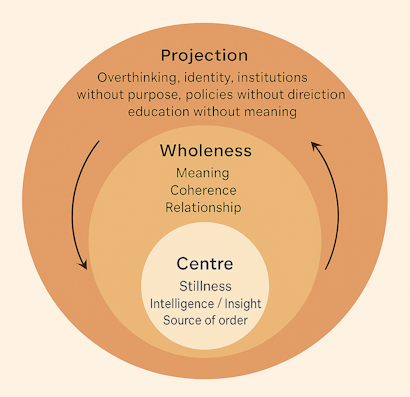
We live amid parts that have lost their place in the whole. Subjects split from meaning. Districts split from a city’s heart. Policies split from a country’s direction. Work split from purpose. Even within us, the thinking self roams outward, busy and determined, while the quiet source that gives it meaning is left behind. This is the single error that repeats under many names. What looks like many crises is one pattern: life moving away from its centre, then mistaking acceleration for progress.
The centre is not a point in space. It is a relation. It is the silent organising principle from which a system understands itself before it acts. In a person, it appears as awareness. In a classroom, it appears as the felt purpose that arranges the parts into a story. In a city, it appears as a living heart where people gather and breathe together. In a nation, it appears as a clear direction that is not owned by any faction, so the parts can differ without tearing the fabric. Whenever this relation is intact, motion flows without friction. Whenever it is broken, effort multiplies while meaning thins.
Begin with the human model because all other systems borrow their structure from it. The projected self is the mind in motion, constructing plans, identities and defences. The centre-source is the field of awareness in which those constructions arise. When the self forgets the centre, it tries to supply meaning with more movement. It reads more, argues more, acquires more, and still feels incomplete. When it returns, insight appears without conflict. Thought continues, but now it serves rather than rules. Decisions that were heavy become simple, not because the world changed, but because the relation was restored.
From this model, education becomes clear. Learning begins from the whole or it never truly begins. When a student first sees the shape of a subject — why it exists, what human question gave birth to it, how its parts fit — attention relaxes and curiosity wakes. The parts then line up. Without that centre, the same parts become noise. Memory works, grades may arrive, but the person remains unchanged because the relation that turns information into understanding never formed. Teaching is the work of restoring that relation each time a new field opens: first the whole, then the parts in their natural order, then a return to the whole so the new knowledge finds its home.
Leadership is the same structure at the national scale. A healthy country is not a compromise of competing fragments; it is a shared centre expressed in many voices. Direction is not a slogan or a quarterly target; it is a lived orientation that survives elections because it precedes them. Where direction is absent, governments react to events and call it a strategy. Regions harden into tribes. The public square turns into a battlefield of narratives. The result is movement without arrival. To lead is to keep the centre present in the common mind so that disagreement can be creative rather than destructive. Then policy becomes the choreography of parts, not the victory of one part over another.
Cities tell the story in stone. The old ones gathered around a well, a square, a market, a temple. The centre gave shape to streets and time to the day. People met without permission. Trade and trust overlapped. Modern sprawl often forgets this. It extends outward without a heart and then wonders why traffic, loneliness and insecurity rise together. When a city rebuilds its centre — not as a monument but as a place where life naturally converges — the scattered parts begin to feel related again. Safety improves because strangers become less strange. Commerce improves because proximity multiplies chance. The city breathes because its lungs are open.
Companies repeat the pattern inside balance sheets. Purpose is not a slogan in the foyer; it is the centre that orders decisions when no one is watching. When purpose fades, departments become rival kingdoms. Short-term wins consume long-term possibilities. Burnout grows because energy is spent compensating for the missing coherence. When purpose is present, teams argue better. Trade-offs are clearer. Projects end when they should end. People feel spent and replenished at the same time because their effort carries meaning. Innovation appears as a side-effect of wholeness, not as a programme to fix fragmentation.
Spirituality is often treated as a separate lane, but it describes the same relation in its most intimate form. Traditions use different images, yet all point to the same movement: the return of the projected self to its source. When this return is real, devotion is quiet, not theatrical. The person becomes simple, not special. Ethics stabilise without surveillance because the centre that sees clearly does not need persuasion to do what is right. When spirituality is organised around the projected self, it produces rules without renewal, spectacle without depth, and communities that protect identity instead of nurturing insight.
Technology, media and markets can either extend the centre or amplify the projection. Tools born from purpose clarify and connect. Tools born from agitation multiply signals and shorten attention until meaning is drowned by method. The test is simple: after using a tool, does the mind return clearer to itself, or more scattered? A society that passes this test repeatedly becomes intelligent as a whole, because its tools carry people back to the relation they most need.
Justice and law mirror the same structure. When justice lives from a centre, it asks what restores the fabric, not just what punishes a part. It remembers that a person is more than their worst moment, and a community is more than its loudest fear. Consequence remains, but it serves healing. When law loses the centre, it becomes a maze where outcomes depend on resources, not truth. Trust erodes and cynicism spreads because the relationship between people and institutions has been replaced by transactions.
Health systems reveal the pattern inside the body. Medicine that lives from a centre treats the person, not the symptom in isolation. It sees sleep, food, movement, connection and environment as one weave. Acute expertise remains essential, yet it plugs back into the whole, so treatment does not quietly create another disease. Where the centre is missing, we treat parts and manufacture chronic illness. Costs rise because coherence is cheaper than fragmentation — but harder to sell.
Even ecology is a lesson in relation. The planet is not a sum of resources; it is a living system whose centre is the delicate balance that makes life possible. Policies that ignore that balance create short-term growth and long-term collapse. Practices that restore it create resilience that looks slow at first and then proves fast when shocks arrive, because systems already related to their centre recover without panic.
Crisis is the moment a system feels its distance from the centre. It appears as burnout in individuals, polarisation in nations, gridlock in cities, scandal in companies and despair in cultures. Attempts to solve the crisis from the same distance tend to deepen it — more rules, more noise, more force. The movement that heals is simpler: stop, return, see, then move. Stopping restores contact. Returning reveals what truly matters. Seeing arranges the parts. Movement after that is efficient because the conflict inside the motion has ended.
How does this feel when it is real rather than theoretical? In a person, it feels like ease without laziness, clarity without rigidity, care without exhaustion. In a classroom, it feels like curiosity that does not need to be bribed. In a team, it feels like disagreement that sharpens rather than divides. In a city, it feels like safety on a walk home and the pleasure of running into someone you did not plan to meet. In a country, it feels like dignity in public life and a direction you can describe in one breath. In a culture, it appears as art that enlarges perception rather than selling distraction. None of this is utopian. It is simply the texture of life when the relation is intact.
The return to the centre is not a retreat from doing. It is the end of compensatory doing. From there, action simplifies. Plans become lighter because they are no longer carrying the burden of supplying meaning. Metrics become honest because they measure what matters. Growth stops being an idol and becomes a description of health. The same hours produce a different world because they are arranged by insight rather than fear.
A theory of everything for human society does not require new jargon. It requires this single movement to be lived across all domains: keep the relation between centre and projection alive. In practice, it means beginning with the whole before the parts, aligning tools with purpose, designing spaces that invite gathering, protecting silence where attention can settle, and measuring success by the coherence we create. When we forget, we do not speed up — we return.
The centre is not elsewhere. It is the constant in which all movement appears. To live from it is not to withdraw from the world, but to let the world be ordered by what does not waver. Then the mind becomes a good instrument, cities become places again, institutions become trustworthy, and civilisation feels less like a struggle against itself and more like a species remembering how to be at home.
The centre we speak of is not a place in the universe. It is not a black hole, a throne, or a point in space. It is the same invisible silence from which both galaxies and thoughts arise. We do not know it as an object — we know it only by returning to it within ourselves. The universe may have its own unspeakable centre — call it Brahman, the Source, the uncreated — but to describe it is already to move away from it. We do not stand outside it to understand it. We live inside it, made by it, moved by it. The centre in us is not separate from that greater centre; it is its reflection, small and temporary, yet true. And though we cannot grasp it with thought, we can sense its intelligence — not as a concept, but as the quiet arrival of insight when the mind becomes still. That is enough to live by.