
The subtle shift from analysis to insight, from effort to unfolding.
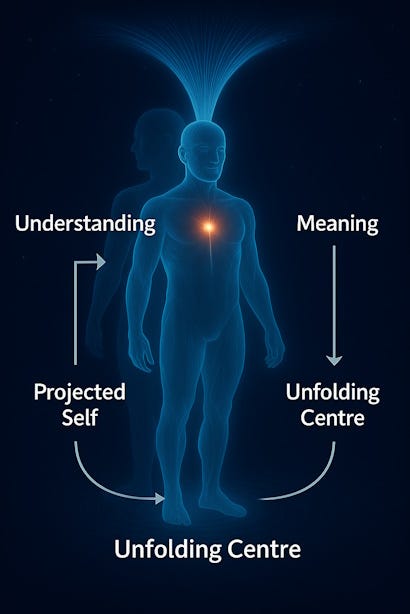
There was a time when understanding seemed like the only path to truth. To live correctly, to make decisions without regret, one believed it was necessary to know everything, to gather knowledge from every corner of the universe and assemble it with thought until the truth finally appeared, whole and without doubt. But this pursuit was endless. Knowledge multiplied, thought compared and analysed, and the mind, exhausted, remained divided. Something was missing. Not more information, but another way of seeing.
Understanding, in the way we have always known it, is the movement of thought. It draws from memory, from experience, from inherited patterns. It moves horizontally — across time — placing one idea beside another, building explanations, solving through addition. Yet because it is built from fragments, it remains fragmentary. One part of the mind reaches a conclusion, another part questions it. Thought argues with itself. There is always another piece of knowledge, another perspective unseen. So understanding never arrives at finality; it remains in motion, unresolved.
Meaning is different. Meaning does not assemble itself from thought. It reveals itself when thought becomes quiet. It is a vertical movement, not a horizontal one. It is not constructed; it unfolds. When the mind is no longer reaching, when it stops trying to fix or complete the world, something opens from within — the centre, the source. Insight appears there. It does not come step by step. It comes all at once, whole, without argument. It is seen, not built.
This is why understanding belongs to time, while meaning belongs to the timeless. Understanding needs effort. Meaning needs silence. Understanding tries to solve. Meaning simply shows.
We separated these two movements deliberately — understanding and meaning — not to create opposition but to see each clearly. If they were spoken of together from the beginning, their distinction would blur. The mind would assume they are variations of the same process. They are not. One is thought grasping for truth. The other is truth arriving when thought lets go.
But now, to leave them separate would be incomplete. In life, they meet. They belong to one intelligence. Thought forms the question. Silence reveals the answer. Understanding shapes the vessel. Meaning fills it.
You can see this in the simplest acts of creation. In the painting studio, there is first struggle — the mind trying to arrange form, colour, proportion. Thought works, revises, doubts. If one keeps forcing through time, no resolution appears. But when the painter leaves the studio, rests, or wakes the next morning, the problem is resolved. Not by more thought, but by meaning quietly arriving in its place. Form becomes clear. The hand knows what to do. It is not magic. It is the rhythm of the mind returning to the centre.
The same happens when imagining a garden gallery — placing paintings among trees, combining cultivated form with wild nature. Thought begins the work: Where will the path go? How will light move across the canvas hanging between leaves? But insight is what completes it. One cannot think the whole into existence. At some point, the mind falls silent — naturally, without effort — and the arrangement appears inwardly, peaceful, whole. Understanding began it. Meaning completed it.

So neither is discarded. Nothing in the brain or mind is a mistake. Thought has its place. It builds, plans, names, and measures. Insight has its place. It sees, aligns, and reveals what thought cannot construct. They do not oppose each other when each remains in its rightful place. Conflict only begins when thought tries to do the work of insight, or insight is expected without the mind ever having looked, questioned, or cared.
In truth, they are like breathing. Understanding is the in-breath — the gathering, the shaping, the movement outward into form. Meaning is the out-breath — the returning inward, the release into the centre. Life requires both. Creation requires both.
This is the quiet climax: understanding is fragmentation seeking wholeness; meaning is wholeness answering. One reaches outward. The other unfolds inward. And when the two are no longer fighting, but moving together, the mind becomes a single, coherent field — capable of thought, capable of silence, capable of truth.
We explained them separately only so each could be seen clearly. But in truth, they arise from the same source. The centre does not belong only to meaning, and thought does not stand apart from it. Thought is the centre moving outward into form; meaning is the centre folding back into itself. They are not two origins, but two movements of one intelligence. When the mind sees this, understanding does not obstruct silence and silence does not reject form. They work as one rhythm — like breathing out and breathing in — each completing the other.

From here, decision and action no longer depend on the strain of accumulating certainty. They arise from a simpler order: the mind looks, thought explores what it can, and when it reaches its limit, it becomes still. In that stillness, meaning appears — not as a reward, but as a natural consequence of no resistance. This is not a technique. It cannot be forced. It happens the way dawn happens when the night stops resisting the light.
So the search is no longer a struggle to collect answers. It becomes a listening. Understanding listens outward into the world. Meaning listens inward into the centre. When these two listenings meet, the mind stands in the only place where clarity is possible — present, undivided, open.
From here, nothing is forced. Thought is free to move when it must; silence is free to return when it will. Action comes as a continuation of seeing. Life proceeds without the old friction of choosing between fragments. There is still work, effort, and uncertainty in the practical world, but inwardly, the ground is no longer divided. One knows what to do when one sees, and if one does not yet see, it is no longer a failure — it is only a signal to be quiet.
We began with the belief that to live without regret, one must understand everything. We end with a different understanding: one does not need to know everything. One needs to see clearly. And clear seeing is not the achievement of thought alone, nor the denial of thought, but the meeting of thought and silence in the centre where meaning unfolds.
In that meeting, understanding is no longer a burden, and meaning is no longer rare. They move together, like two currents of the same river — one shaping the banks, the other carrying the water. And the mind, no longer divided between effort and insight, becomes what it was always capable of being: a place where truth can be seen and lived without conflict.
It is the natural turning of the mind — from understanding as effort, to meaning as wholeness unfolding from the centre in silence.