
There is a point in this journey where thought can no longer carry us further. You begin to notice that every attempt to solve yourself with yourself only pulls you further from the quiet centre where all things begin. What you once trusted — analysis, effort, intention — starts to reveal its limitations. Not because it is wrong, but because it was never meant to take you all the way home. The mind fragments to understand, but the source does not live in fragments. It lives whole.
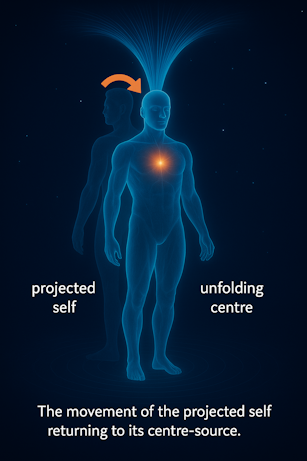
We start here because this is where it all begins: with the sense that nothing in us is useless, and nothing is to be denied. The self, even in its confusion, is not a mistake. It is only a movement outward from the source, stretched too far into thought and divided perception. And what stretches out can return. Insight is this return — the quiet flipping of the self back into the centre-source from which it first arose. It is a movement in the living mind.
When the self extends away from the centre, it tries to solve life from outside of life. Thought builds structures, opinions, and beliefs. It separates the world into pieces in order to understand it. In doing so, it loses the very thing it is seeking — wholeness. But when insight strikes, something else happens. The self does not continue outward. It turns, softly, like a leaf in still air, and falls back to where it came from. The centre. The source. The place beneath thought from which thought is born.
In this return, there is no violence. No rejection of the self. It is not destroyed. It is dissolved into its origin, like a wave receding into the sea. And here, something extraordinary becomes ordinary: the centre-source begins to respond. But it cannot respond when the self is loud, occupied, and constructing its own answers. The source does not interrupt. It waits. And only when the self becomes silent — truly silent — does the source begin to speak as insight.
This is why silence is not absence. It is communion. It is the doorway through which intelligence flows. People speak of no-self and mistake it for disappearance. But it is not about becoming nothing. It is about no longer standing between yourself and the source. The self bows. It returns to its birthplace. And in that returning, it becomes transparent. Life sees through it again.
We return to the simplest truth: nothing in us is useless. The self, thought, emotion, memory — none of it is an error. All of it arose from the same source. But when the self extends itself away from that centre, when it tries to operate without returning to where it was born, fragmentation appears. Thought begins to divide what in reality has never been divided. It creates questions and then tries to answer them from the same place they were created. This is why suffering loops. The self leaves the centre, tries to solve itself from outside its origin, and in doing so, multiplies distortion.
The mind fragments only to understand, but understanding can never be whole while it stands outside its own source. This is why every answer gained through thought alone eventually dissolves into another question. The self solves a problem only to create a new one beside it. It is not a failure — it is simply the nature of a self that has moved too far from the place of its birth. And yet, this movement outward has a purpose. It shows us the cost of distance. It leads us to the threshold where thought can go no further and something quieter must take over.
Insight does not come from effort. It appears when the self stops interfering. When the movement of thinking returns to silence, the source begins to see on our behalf. This is the turning point. The self does not disappear — but it bows. It softens back into what made it. Only then can the centre-source respond. How can the source solve what it has not been shown? How can it answer a question that has not been surrendered to it?
This is why silence is not absence — it is communication. It is the way the self returns to the origin and says, without words: here is what I cannot solve from the outside. And in that silence, the centre-source sees, understands, and responds — not with noise, not with argument, but with a single, quiet movement called insight.
At a certain point, the self begins to sense this. An understanding that no matter how refined thought becomes, it cannot touch the root of what is asking to be known. This is where the final turning begins. Not the rejection of the self, but its return. The self must be shown how to fall back into the place it first arose from, like a wave dissolving into the sea. This is what we call silence. Not passivity, not suppression, but the self no longer scattering itself across time. It rests. It waits. It listens.
This is how the source begins to answer — not through force, not through will, but through the quiet return of the self to where it came from. A question placed in silence is not ignored. It is received by the centre that birthed the self in the first place. And from that stillness, a response arrives — not as thought layered upon thought, but as insight. This is why silence is not the absence of self, but the alignment of self with its origin. Only in such alignment can the source respond clearly.
And it is from this point that the idea of no-self must be understood correctly. No-self is not the disappearance of who you are. It is the self no longer standing between you and the source. It is the self stepping back into silence so that the centre can see clearly. When teachers spoke of the end of self, they meant the end of resistance — not the end of being. The self remains, but it is clear, unburdened, and obedient to what moves through it. This is the centre of the transformation process of the self when it is in its source.
From here, the self does not vanish — it learns when to move and when to be still. It speaks only when called by insight and rests when silence is enough. This is not extinction; it is harmony. The self becomes an instrument rather than an interference, a window rather than a wall. And in that clarity, life begins to move as one whole, without the constant interruption of a self trying to manage what the centre already knows….
Yet even this transparency of self is not the end. It is the beginning of living from the centre. Thought still appears, but it no longer argues with life. It listens. Insight arises, but it is not separate from thinking — it moves through it. This is what it means when thinking and insight become one. The source does not erase the self; it uses it, gently, precisely, only when needed. And when it is no longer needed, the self falls silent again, without struggle.
From here, awakening is no longer an event but a way of being. Life does not become extraordinary; it becomes real. Simple acts — walking, speaking, resting — are no longer separate from the centre. There is no longer someone trying to live spiritually, and a world resisting it. There is only life moving from its origin without interference. Problems still arise, but they are brought back to the source, not spun into chaos by thought. The response comes, as it always has — quiet, accurate, kind.
This is the final step: not the disappearance of life, but the disappearance of distance. The centre is no longer visited in moments of clarity; it becomes the ground we never leave. And from here, the world is whole again — not because it has changed, but because we have stopped standing outside of it.
In this way, awakening is not a moment but a settlement. It is not a peak to hold, nor an experience to repeat, but the quiet recognition that the centre has always been here — waiting for the self to return. Life goes on. You speak, you work, you feel joy, you feel sorrow. But something fundamental has changed: you no longer leave the centre to live. The movement outward and the return inward are now one seamless gesture. Action and stillness are no longer opposites.
The world does not become perfect, but it becomes whole. Problems may still appear, yet they are no longer carried by the mind alone. They are brought to the source and answered there. And the answer does not always come as words — it may come as a shift in perception, a softening inside, a knowing without thought. This is the final step in understanding: insight is not something you make. It is something you meet.
So the journey that began with fragmentation ends in simplicity. Not because complexity has vanished, but because everything now rests on one foundation — the centre from which all things arise and to which all things return. Nothing is rejected. Nothing is outside the One thing. And in this wholeness, the self is free to appear and disappear without conflict. It is no longer the doer. It is the instrument of something deeper.
Here, the search ends — not in conclusion, but in clarity. Not in escape, but in arrival. And in the stillness of that arrival, life begins again — ordinary, luminous, indivisible.
This is where the journey ends and living begins. The centre is no longer something you return to — it is the place from which everything moves. There is no effort to stay here, no discipline to maintain it. The silence holds itself. Insight appears when needed, thought follows when called, and both rest when their work is done. Nothing is rejected, nothing is clung to. Life moves, and you move with it — not as someone seeking, but as the space in which seeking is no longer necessary.
And so, the self is not destroyed. It has simply remembered its place. It rises from the source and returns to it, like breath. This is the final step into awakening — not the disappearance of who you are, but the discovery of what you have always been. The one movement behind thinking, feeling, living. The centre-source that waits in silence for the self to come home. When this is seen, the search ends — not because there is nothing left to find, but because you are already standing at the place from which everything is found.
The transformation, then, is not the erasing of who we are, but the returning of the self to where it began. When the self stops trying to think its way out of life and falls back into the quiet of its own centre, something deeper begins to respond. Insight appears — not as a product of effort, but as the natural movement of the source seeing through us again. Thought does not create it; thought becomes still enough for it to arrive. And in that stillness, the self is not destroyed — it is realigned. It becomes transparent to the centre from which it came, and through that transparency, it is quietly transformed.