
Subtitle: Insight is the mind’s way of seeing meaning directly.
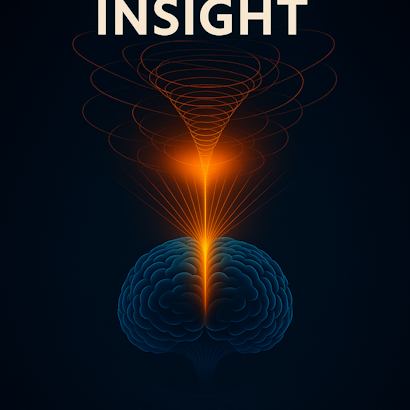
Insight is not something the brain calculates or invents. It is not thought rearranging information. It is what happens when perception is allowed to move inward without interference and becomes understanding. Insight is perception completing its movement. It is intelligence in silence — where the mind is no longer grasping, comparing or projecting, but simply clear enough to receive what is already there.
Thought cannot produce insight. Thought is always old. It is made of memory, of what has been known and experienced before. It can modify, compare, analyse, and extend what it already knows, but it cannot step beyond itself. Insight is different. It arrives not through effort, but through stillness — when the mind is attentive without strain, and quiet without suppression.
Insight begins in the same place as perception. Perception sees what is. But where perception often stops at form, insight continues into meaning. It does not break experience into pieces in order to understand it. It meets it whole. It is not built by logic; it arrives as a direct seeing. That is why it feels sudden, effortless — like light revealing a landscape that was already there.
It may appear as though insight comes from nowhere. Yet it comes when the mind is no longer clouded by resistance, fear, or the need to defend an image of the self. When the surface of the mind is disturbed, like a rippled lake, what is reflected becomes fragmented. But when the surface becomes still, without force, the world reflects itself clearly. In that stillness, insight appears.
Insight carries no conflict because it is not divided. It does not argue with what is seen. It does not seek to change it, nor to protect the self from it. It is simply the direct meeting of truth. From that meeting, action is not chosen between alternatives; it flows naturally — without effort, without regret, without resistance. It is action in harmony with reality.
This movement of insight is similar to how nature creates form. A proton is not a solid object; it is a stable whirlpool in the quantum vacuum, a continuous inward and outward flow held in balance. A cell is a boundary where chemistry, water and information circulate and sustain life. In the same way, the brain is not merely a machine of thought. It is a place where reality can enter and be held — long enough for understanding to emerge.
When perception flows inward and is not stopped by the noise of thought, it reaches the silent core of awareness. There, instead of being captured by memory or bent by emotion, it organises itself into understanding. This is insight. It is not a conclusion; it is a revelation. It does not come from the past; it is born in the present.
Insight is the mind aligned with reality. Not reality as imagined or desired, but reality as it is. It is the universe touching awareness without distortion. It is what remains when the mind is quiet, alert, and free of resistance. In that quietness, intelligence is not personal. It does not belong to “me.” It simply operates — clear, compassionate and whole.
Such intelligence does not create inner conflict because it does not act out of fear or conditioning. It acts out of seeing. And when seeing is complete, action is complete. There is no residue of doubt, no division between the observer and the observed. There is only movement — like water flowing downhill, like light spreading into darkness.
Insight cannot be summoned. It cannot be manufactured by method or discipline. But the mind can become quiet, attentive, unburdened by the weight of thought. In that silence, insight comes naturally — like dawn after night, like breath after stillness. It is not an achievement. It is the natural flowering of a mind that has stopped interfering with what is true.
To live with insight is to live without inner contradiction. It is not a mystical state or a special gift. It is the most natural state of a human mind that is awake. Insight is not the end of thought — but the right place of thought. Thought becomes a tool, not a master. Silence becomes the ground, not the absence. And intelligence moves without conflict, because it moves with life, not against it.
In the end, insight is meaning arising from silence. Not the meaning we fabricate to feel safe, but the meaning that is revealed when the mind no longer interferes. After all the noise of thought and the chaos of interpretation, insight is the moment when perception touches truth and order appears. It does not create meaning — it sees it. And in that seeing, the mind is no longer in conflict. It understands. It moves with life, not against it. Insight, then, is not an answer — it is the quiet recognition of meaning already present in the fabric of what is.