
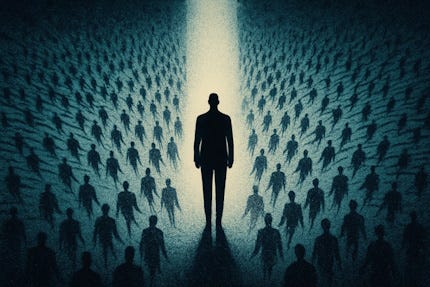
Democracy promises freedom, but freedom without structure drifts toward disorder. In a world where polarisation widens, inequality compounds, digital systems amplify extremes, and geopolitical tensions multiply, entropy is accelerating across every level of society. Consensus politics — the calming force of the late 20th century — now looks too slow and too soft to hold a fracturing public together.
A new paradox has emerged: leaders are rising to power through democratic legitimacy, yet are forced to govern with concentrated authority. They are democratic dictators — not in morality, but in structure — tasked with compressing societal entropy before it tears the system apart.
When Consensus Reaches Its Entropy Limit:
Hu Jintao’s “Harmonious Society” in China was once the ideal of a technocratic middle path. His leadership operated through restraint, collective decision-making, and an attempt to smooth extremes before they became dangerous. It was governance by calibration: enough growth to satisfy the masses, enough welfare to soften the edges, enough committee rule to prevent dominance.
But entropy seeped through the cracks. Inequality widened. Corruption deepened. Collective leadership blurred responsibility, making the system flexible but indecisive. What was meant to keep society in balance instead permitted divergence to grow unchecked. When Hu later acknowledged failures in inequality and corruption, it marked the quiet end of the consensus era.
The entropy phase of soft governance had run its course.
The Emergence of Democratic Dictators:
Into this vacuum stepped a new leadership archetype: rulers who claim popular legitimacy yet consolidate authority in order to reset disorder. They do not govern by persuasion but by coercion.
Nayib Bukele (El Salvador)
The mega-prison and mass arrests violently collapsed gang entropy. Crime plummeted. Rights were suspended. Bukele justifies force as democracy’s last defence.
Donald Trump (United States)
Disruption became his method of coercion. By breaking political norms, he channelled public frustration into a narrative of restoration. Institutional order gave way to populist resistance.
Vladimir Putin (Russia)
Stability through centralisation. Putin compresses entropy with state control, projecting national sovereignty as fairness and safety.
Xi Jinping (China)
An ideological revival replaced Hu’s consensus. By elevating personal authority and fostering coherence, Xi consolidates unity through discipline.
Their contexts differ, but the structural pattern is the same: entropy is met not with dialogue but with forceful realignment. These leaders do not behave as traditional authoritarians; they are electoral autocrats, democratically mandated strongmen who blend legitimacy with concentrated power.
Their methods differ ethically, but the structure of power they use is similar.
Leadership as Entropy Management:
The central challenge of modern governance is no longer mere administration. It is thermodynamic: how to contain the social, digital, emotional, and economic entropy generated by a hyperconnected world.
Although these leaders fall under the same structural archetype, the way they compress entropy is distinct. Some do it through ideological tightening, reducing deviation and reinforcing a coherent centre. Others recycle disorder back into controlled participation, using systems of rehabilitation to absorb margins. Some disrupt existing norms to reset a stagnant equilibrium, channelling public frustration into political realignment. And some rely on punitive force — collapsing violent entropy through fear and mass incarceration in the name of safety. Each uses a different mechanism, but all are responding to the same rising pressure: a society whose disorder demands the restoration of order rather than consensus. What unites them is not the method but the necessity.
The ethical question is whether such power can be used without corruption or cruelty — whether a leader can be strong enough to manage entropy yet legitimate enough to remain democratic.
Consensus leadership has reached its structural limit. The pressures of the 21st century reward those who can contain disorder, restore coherence, and still claim a democratic mandate. The resulting figures are democratic dictators — leaders shaped by the electorate yet forced to rule with concentrated authority.
This is not an endorsement, but a description of the forces at work.
In an age of accelerating disorder, the leaders who endure will be those who understand that modern governance is no longer just politics — it is entropy management backed by legitimacy.
Future of Human Rights:
As democratic dictatorships become the structural response to rising disorder, the future of human rights will shift from an absolute ideal to a managed equilibrium. Rights will still exist, but they will be filtered through the logic of entropy control: freedom balanced against stability, expression balanced against cohesion, privacy balanced against security. States will increasingly justify tighter boundaries not as repression but as maintenance of social coherence in a world of accelerating divergence. Human rights will not disappear; they will adapt into a new form — dynamic, conditional, and continuously negotiated between individual autonomy and the system’s need to hold itself together.