Karta Purkh: The Living Centre of the Guru Granth Sahib

Mool Mantar, the morning prayer of the Guru Granth Sahib (GGS), the Sikh Holy Book. This morning prayer is on the very first page of the GGS.

Ik Onkar (oneness of existence)

Satnam

Karta Purkh (brings this oneness into motion, where all else of the GGS unfolds from this centre)

Nirbhau

Nirvair

Akal Murat

Ajooni Saibhang

Gur Prasad.

The opening words of the Guru Granth Sahib, the Mool Mantar, are like the seed from which the entire scripture unfolds. Every word that follows is the flower and fruit of that seed. The first line, Ik Onkar, establishes the oneness of existence, the indivisible source that holds all forms and all formlessness together. The second line, Karta Purkh, brings this oneness into motion — the moment where the still source becomes the creative act without ever leaving its stillness.

Karta means the doer, the maker, the creator. Purkh means the person, the being, the essence of consciousness that acts. When joined, Karta Purkh does not describe two separate things — a creator and a creation — but the inseparability of doing and being, of movement and stillness. It is the point where the fountain of life begins to flow from its own centre, yet never departs from it. In that sense, Karta Purkh is the living centre of the Guru Granth Sahib — the heartbeat within its still silence.

All that the Guru Granth Sahib expresses, the hymns, the metaphors, the reflections on truth and illusion, can be seen as the continuous unfolding of that centre. The Guru’s voice is the fountain, flowing outward in words, returning inward in realisation. The Mool Mantar is not a preface but the entire map: the unfolding of divine self-awareness from its own silence. When the seeker recites Karta Purkh, they are not merely remembering God as creator; they are aligning with that creative stillness within themselves, the source from which thought, action, and breath arise.

To understand Karta Purkh is to sense that the act of creation never ended. The world continues to emerge in every moment from that centre, through stars and rivers, through consciousness and awareness, through every act of love, compassion, and knowing. The second line of the Mool Mantar is thus not a statement but an instruction: it reminds us to stay at the centre of the fountain, where doing happens without the doer. From there, the rest of the Guru Granth Sahib becomes an endless meditation on this truth — that the universe itself is the hymn of Karta Purkh, the song of stillness moving in eternity.

When compared to the traditions of Hindu philosophy, the distinction becomes luminous. Hinduism, even in its highest Vedantic insight, often circles around the self, using story, mythology, and the cycles of time to point back toward the centre. The seeker begins from the self and journeys inward through the layers of form, symbol, and remembrance. The movement is centripetal: from the outer to the inner, from the many to the one.

The Guru Granth Sahib moves in the opposite way. It begins at the centre itself and unfolds outward as living presence. It does not circle toward the truth; it speaks directly from it. Its verses are not stories told about the past but manifestations of the now, the eternal Akal Purakh — timeless being. This is why the Guru Granth Sahib is not time-based: it has no mythology, no beginning or end, only the continuous pulse of the present moment. It is not a scripture of remembrance but of revelation — of consciousness unfolding from its own source in every instant.

In that sense, Karta Purkh is both the origin and the ever-present act of creation. The Guru Granth Sahib is its living breath, the unfolding of the eternal now. Each verse, each sound, is the fountain of the centre expressing itself again and again, reminding us that creation is not a past event but the continual awakening of being within itself.

Waheguru Ji Ka Khalsa, Waheguru Ji Ki Fateh.

ਵਾਹਿਗੁਰੂ ਜੀ ਕਾ ਖਾਲਸਾ, ਵਾਹਿਗੁਰੂ ਜੀ ਕੀ ਫਤਿਹ।

Meaning: The Khalsa belongs to the Divine, and victory belongs to the Divine.

A greeting and a declaration — a living reminder that the creative act, Karta Purkh, and the fruit of all action belong to the same still centre.

Guru Granth Sahib
Karta Purkh

Related Images:

The Living Centre: The Moment of Transformation

When the watcher dissolves, life speaks for itself.

This piece traces the precise moment where the observer dissolves into the observed — not as theory, but as direct transformation. It is written to be experienced, not understood.

There is a shift that cannot be rehearsed. One moment, you are the one seeing — the next, there is only seeing itself. The watcher and the watched collapse into a single field. This is the moment transformation truly happens.

Before this, everything feels like effort. The mind moves toward understanding, cataloguing, interpreting. Even the desire for stillness becomes a form of reaching — subtle, persistent, exhausting. The self stretches outward, trying to hold its shape against the silence that threatens to absorb it.

But at the threshold of exhaustion, something gives way. The leaning ends. The movement stops. The observer is no longer watching stillness — it is stillness. The fountain and its water are one.

This is the transformation itself — the shift from looking at the centre to moving within it. Before, the self existed as an extension of the centre, oscillating between stillness and motion. Now, there is no extension. The movement is happening inside the centre itself — effortless, luminous, whole.

You feel this not as a new state but as the absence of all states. The watcher has dissolved, yet perception is untouched. Sound remains sound, light remains light, the body continues — but there is no boundary left between you and the act of perceiving.

This is the living centre: not an escape from life, but life itself in motion without the self as mediator. Awareness folding into its own reflection, unbroken.

In the past, you looked from the edge, tracing the rise and fall of the self — seeing the leaning begin, watching it end. Now the fountain flows within you. There is no longer a ‘you’ outside the flow.

The difference between the before and after is simple but immeasurable. Before, awareness belonged to a person. After, the person belongs to awareness.

This is not a higher condition but a natural correction — the return of energy to its source. The stillness that once seemed outside you is now the field of all movement. Action arises, but there is no actor. Choice appears, but there is no chooser.

The living centre breathes everything at once — birth, decay, renewal — without resistance, without hesitation. This is how the universe itself lives.

And this is how you live when you no longer stand apart from it.

Not centred in the centre.

But as the centre.

Transformation
Living The Centre

Related Images:

Tathagata: The Place They Spoke From

Speaking from the centre that does not move. Always is. Only the self moves and projects.

The awakened ones who came before us — Buddha, Jesus, Nanak, Krishnamurti — all spoke from the same place. It was not a location in space, but a state of being: the centre that does not move. They saw from there, spoke from there, and returned to silence when the words were done.

There is a place in the mind where nothing moves. Not silence as the opposite of sound, not calm as the opposite of agitation, but the ground before either appears.

This is the centre. The one that does not come and go. The one that does not begin and does not end.

Buddha sat in this. Jesus spoke from this. Nanak sang from this. Krishnamurti pointed to this.

They did not teach a method. They did not create a path. They did not offer a belief.

They simply did not move away from the centre.

The world moved. Life unfolded. Speech came. But the centre remained still.

This is why their words do not decay. They are not personal. They are not held up by identity. They are not shaped out of memory.

They emerge directly from the unmoving ground.

No lean. No reaching. No becoming.

Only the natural expression of awareness when it is not forming a self.

We begin here.

They did not speak to convince. They did not speak to guide. They did not speak to lead others somewhere.

Speech arose the way breath arises: naturally, without intention.

When the centre is still, words are not crafted. They arrive. They appear as needed and disappear when they are finished.

There is no speaker inside. There is no one choosing what to say. There is only speaking.

This is why their words have no weight on the mind. Even when they cut deeply. Even when they undo everything you believe.

The words do not carry a self. And so the listener does not feel defended.

It is not one person speaking to another. It is awareness recognising itself.

This is why people cried in their presence. Not from devotion. Not from worship. Not from emotion.

But because, for a moment, the movement of becoming stopped. And they tasted what had always been here.

The centre speaking. The centre hearing. The centre recognises itself.

No distance. No one in between. No effort at all.

Each one expressed the centre differently. But the place they spoke from was the same.

Buddha spoke in stillness. His words were spare, clean, without ornament. A reflection of the mind that does not reach.

Nanak sang. His voice moved the way water moves around stone, without effort and without interruption. Song was the most natural form for truth to take in him.

Jesus spoke with presence that dissolved the listener. Not persuasion. Not authority. Just a depth of being so silent that the self could not stand in front of it.

Krishnamurti spoke like clear light. Not poetry. Not scripture. Only the movement of the mind revealed in real time.

Different language. Different time. Different culture. Different expression.

Same centre.

The river takes the shape of the land it flows through. But the water is the same.

Truth takes the shape of the one who expresses it. But the ground it rises from does not change.

It is the same ground in you. Right now.

Not in some future moment. Not after purification. Not after understanding.

But here. Before the mind leans. Before the self arranges itself. Before the world is remembered.

The centre does not need to be found. It is what remains when nothing is being held.

When the centre remains, life does not become still. The world does not pause. The senses do not stop.

Only the movement of becoming ends.

There is thought, but no thinker. There is action, but no actor. There is speech, but no speaker.

Life continues in its natural rhythm. Simple. Unforced. Unbroken.

You do not withdraw. You do not rise above. You do not transcend.

You simply do not lean.

Without the lean, there is no self to maintain. No identity to protect. No image to uphold.

You move through the world without being moved by it.

This is how they lived. Not as teachers. Not as enlightened beings. Not as figures of reverence.

But as those who did not leave the centre.

They walked. They ate. They sat. They spoke. They rested. They breathed.

Just as you do.

The difference was only this: They saw the movement of the self begin — and they did not follow it.

No practice. No suppression. No effort.

Just the simple recognition:

The centre does not move.

And so they remained where everything begins. And everything returns.

The place you are now.

The place you have always been.

The One Who Does Not Come and Go

Buddha did not call himself enlightened. He did not call himself a teacher. He did not call himself a guide.

He used one word:

Tathāgata — the one who does not come and does not go.

Not as a title. Not as a role. Not as something to become.

But as a description of the centre.

The centre does not arrive. It does not depart. It does not begin or end. It does not become anything.

Only the movement of the mind comes and goes. Only the self appears and disappears. Only identity forms and dissolves.

The centre remains.

When Buddha said “Tathāgata,” he was simply speaking from the place that does not move.

The same place that speaks now.

The one who has gone nowhere.

The one who has always been here.

Tathagata
The Centre Does Not Move
Self Comes And Goes

Related Images:

Jesus, Judas, and the Gravity of Karma

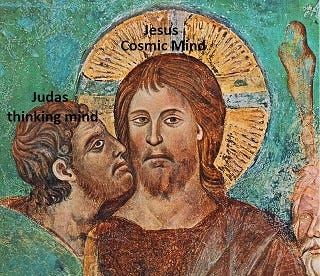
When Jesus sat among his disciples and said, “One of you will betray me,” he wasn’t foretelling tragedy; he was seeing the movement of the self. His centre was still, unmoving, timeless. From that stillness, he could see how the mind of another — Judas — was leaning, how the self was beginning to form and move toward its act.

Judas’s betrayal was not evil in the moral sense. It was the movement of separation itself — the self trying to define truth from outside the centre. The betrayal was a cosmic event replayed in human form: the moment awareness separates from stillness to know itself. That separation is the beginning of time, of karma, of suffering.

The moment the self moves, karma begins — not as punishment, but as psychological gravity. The self creates an orbit of tension, an imbalance that must return to stillness. This return is what we call the dissolution of karma. The centre never moves; only the self does. And when that movement is seen clearly, when there is no effort to correct or control it, the motion stops. The self dissolves, and the weight of karma disappears instantly.

This is the meaning of Judas’s remorse and death — not divine retribution, but the natural collapse of the self’s orbit back into the stillness it left. The suffering is not the centre punishing the self; it is the self exhausting its movement.

Krishnamurti said, “Do nothing. Just see.” He was describing this same return. The mind cannot dissolve karma by effort because effort is movement. It can only dissolve by seeing its own motion without choice. To see clearly is to end movement. The centre needs no purification — it was never touched.

Jesus knew this in silence. His crucifixion was not sacrifice but demonstration: the still centre meeting the chaos of the self and remaining unmoved. His words, “Forgive them, for they know not what they do,” came from the centre that sees without judgement — the awareness that knows the self is lost in its own movement, believing in choice where there is only cause and effect.

This is the law of karma, not as moral accounting, but as balance in consciousness. The self moves away from stillness, creating resistance. Suffering begins. The self exhausts itself in its struggle, and in the seeing of its futility, returns. Karma ends the moment there is nothing left to continue it.

The Buddha called this cessation. Krishnamurti called it insight. Jesus called it the Kingdom within. All were describing the same mechanism: when awareness returns to stillness, time ends, karma ends, and action flows without a self.

So the story of Jesus and Judas is not about betrayal and punishment. It is the story of every mind — the still centre and the self that leans from it, the movement that creates the world, and the seeing that brings it all home.

Karma, then, is not a sentence; it is a return. The only price is psychological suffering. The only liberation is the end of leaning.

The centre never leaves you. It waits in silence for movement to tire itself out.

And when it does, creation, forgiveness, and truth — all return to the same place: the unmoving centre of awareness, where there is no doer, no act, no past — only stillness.

Just remember what you did to Jesus with the thinking self:

Jesus And Judas
Centre And Self

Related Images:

Two Minds Speaking — Before the Self Knew What It Was

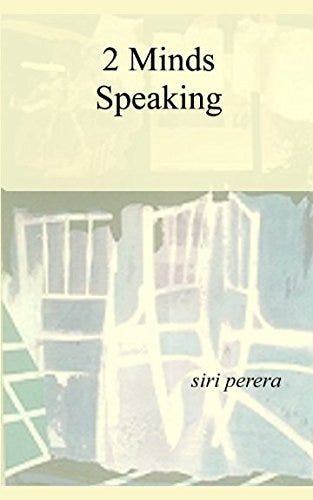
In 2018, when I wrote 2 Minds Speaking, I thought I was exploring the nature of empathy and the strange world of internal speech. I was fascinated by how the mind speaks to itself in silence — how thoughts form as subvocal sound, how self-talk becomes the shape of our psychological world. But I now see that what I was truly exploring was not empathy, nor psychology, nor art. I was recording the very movement of mind that would later reveal itself as the self.

I had no technique. The lines came automatically, like breath, like weather. I let them appear without interference. I resisted the urge to edit, to refine, to impose order. The words were given, not made. I called it automatic writing, but it was something deeper — it was awareness speaking before understanding had caught up. I thought two minds were speaking: one emotional, one observing. But there were never two. There was only movement and stillness, voice and silence, self and centre beginning to find each other.

The poem unfolded through empathy. The repeated refrain — me sad when… me sad when… — became a mirror of consciousness. Every image — a fox limping, a tree breathing, a mother losing her child to the sea — was not just observation; it was identity dissolving into perception. The pain of others was not imagined. It was directly felt. That was the beginning of non-duality, not as concept but as emotion. Empathy was the bridge between separation and wholeness.

The unedited flow of words mirrored the unfiltered flow of being. I see now that each image was a fragment of self returning to silence. I was documenting the fall of identity in real time, long before I had the language to describe it. What I thought was my imagination was the first opening of the centre — the point from which all perception unfolds. The poem was not written about the centre. It was written from it.

Halfway through, the voice in the poem shifts. It begins to say, watch your mind, right now, not today, not tomorrow, but this instant. I did not know it then, but that was the centre revealing itself through speech. The duality collapsed into a single awareness that was watching itself think. It was the first articulation of stillness. The observer and the observed were becoming one.

And then, at the end, the poem softened into an image so simple, I missed its truth for years: I wondered if slugs were snails who left their homes behind. It was more than a metaphor. It was a prophecy. The shell was the self, heavy with identity, history, and fear. The slug was consciousness without its protection — vulnerable, soft, and free. The line contained the entire movement of transformation. The self does not awaken; form simply dissolves into the centre.

Looking back, 2 Minds Speaking was never a dialogue between two voices. It was the sound of awareness finding form in language. It was the self watching its own creation and beginning to fade. The empathy that poured through those lines was not emotion — it was perception without distance. What began as poetry became a record of transformation, the moment when thought, language, and feeling all returned home to silence.

The two minds were never two. They were one awareness speaking to itself, learning its own nature through rhythm and word, until even the speaking ceased.

Losing the self was never a loss. It was the release from protection that never truly protected. The shell had only ever been a boundary drawn by fear — a home that existed to preserve the illusion of separateness. When it fell away, what remained was not emptiness, but infinite space. The self did not die; it simply stopped pretending to be the whole. And what appeared instead was the freedom that had been there all along — soft, unguarded, limitless.

Voices from the Original Transmission

Before understanding had language, the early self spoke in images. The words were raw, uncorrected, and closer to the movement of life than to the logic of the mind. These are fragments from that time — echoes of the centre before it was seen:

Watch your mind, not about tomorrow or yesterday… not today, but right now, yes now. Bring it back further to right this moment. You came out of the ether like some magic, and here you are.

The self was watching itself appear. The voice thought it was alone, yet it was being watched by silence. What seemed like thought was the centre speaking through time.

Then I thinking, who made that tree? Where it come from? That tree always been around. Carpenter did not make that tree. Tree and grass same thing. They grow with your body, with your feeling.

Already the insight was there — the sense that creation does not begin with a maker. The mind was describing the universe as it describes itself through form.

Sometimes we very sure, like Jesus he very sure until people hang him with nail on cross… You see no good and no bad, but you know something keep all accounts.

Even then, the words were tracing the field of balance, the restoration that arises when stillness returns.

And finally, the closing image — the prophecy that waited years to reveal its meaning:

I wondered if slugs were snails who left their homes behind.

The shell was the self. The slug was consciousness without its armour — soft, unguarded, free. The home that once protected had become a prison. When it fell away, only openness remained.

The early voice did not know what it was saying, but the centre did. It was speaking through the folds of time, preparing itself to be seen.

Evolving Into Sahaj
Sahaj
Centre And Self
Poetry
Automatic Writing

Related Images:

Non-Duality: The End of the One Who Experiences

Self dissolves into the centre

Most people hear the word non-duality and immediately turn it into a belief.

They say:

  • “Everything is one.”
  • “There is no separation.”
  • “The world is illusion.”
  • “Only consciousness exists.”
  • “The self is a dream.”

These statements may point toward something real, but the moment the mind repeats them, a knower appears. A centre of ownership. Someone who claims to understand.

Duality returns.

Non-duality is not about understanding what is. Non-duality is about seeing the one who is trying to understand.

How Duality Appears

Duality is not built into reality. It is created by the mind.

It happens in a single moment: when the mind leans toward experience.

When there is no leaning, there is simply seeing, hearing, and breathing. Experience is happening, but there is no one at the centre of it.

This is the centre. Still. Silent. Aware.

Then the mind moves. It reaches. It says, without words: “This is happening to me.”

The lean creates two:

  • a “me” who experiences
  • a world that is experienced

Duality is not real. It is a movement.

The Self Only Exists While Leaning

The “self” is not a thing. It is not a soul. It is not a person.

It is only the movement of mind reaching toward experience.

No lean → no self. Lean → the self appears.

Like a fist that exists only while the hand is clenched. Release the tension, and the fist is gone. The hand remains.

The centre remains. The self was only movement.

Non-Duality Is the Absence of the Lean

Non-duality is not unity. It is not oneness. It is not merging with everything. It is simply:

Experience without the one who claims to experience it.

Seeing without a seer. Hearing without a hearer. Living without someone living life.

Life is happening. The “someone” was extra.

The Closing

The self is the one who learns, compares, remembers, and reaches. It leans toward experience and calls the leaning “me.”

But the centre does not learn. It does not accumulate. It does not become anything.

It simply unfolds.

Not from effort. Not from understanding.

But from its own stillness.

When the leaning ends, the self ends.

What remains is the centre, unmoving, yet alive with everything.

The self learns. The centre unfolds.

The self does not awaken. Awakening is what happens when the claim over experience dissolves. Form remains — the body moves, speech happens, thought appears — but none of it is held as “me.” There is doing without a doer. Seeing without a seer. Life moving without someone inside it controlling the movement. The centre never needed to awaken — it was already whole. Only the leaning, the contraction, the identity had to be seen. When that movement ends, what remains is simple, natural, effortless presence. This is not the self becoming enlightened. This is enlightenment appearing when the self no longer needs to be there.

Non-Duality:

This is how Buddha meant Nirvāṇa:

The flame goes out because fuel is no longer added.

This is how Nanak meant Sehaj:

“Effort ends. The river returns to its source.”

This is how Krishnamurti meant Freedom:

“The ending of the known is the beginning of the real.”

This is how Jesus meant The Kingdom is within:

It does not come through effort. You see it, and the self dissolves into the centre.

Non Duality Mind Process
Self Dissolves In Centre

Related Images:

Sehaj — stillness while life moves

We begin where all traditions meet.

Not in belief. Not in scripture. Not in philosophy.

But in the quiet before thought. In the stillness that is present before the mind leans.

This stillness is not something to achieve. It is not created through discipline or effort. It is not produced by meditation or practice.

It is already here. The natural state. The ground. The centre.

In Sikh language, this is Sehaj.

Not peace. Not calm. Not trance.

Sehaj is the mind at rest in its own nature.

Stillness while life moves. Silence while speech happens. No effort anywhere.

A river flowing without a boatman. A wind moving without a direction. A thought appearing without a thinker.

Sehaj is not the absence of experience. It is the absence of leaning toward experience.

Awareness remains open. The world arises within it. Nothing is resisted. Nothing is grasped.

This is the natural state of being.

The Fall Into Effort

Sehaj is not lost. It is covered.

The covering begins when the mind leans. A small movement. A reaching toward what appears. A tightening around experience.

This leaning is the birth of the self. Not the mystical Self — the ordinary one. The one made of memory, reaction, preparation, and defence.

Before the lean, awareness is open. After the lean, awareness becomes a point.

This point calls itself me.

This is not an error. It is not a flaw. It is simply how the mind organises experience.

But once the point forms, it begins to act on behalf of itself.

It tries to secure. It tries to continue. It tries to control.

This is where effort begins. Not physical effort. Not work.

Effort of identity. The effort of becoming. The effort of trying to be someone in the world.

This effort is subtle, constant, exhausting.

And yet —

It was born from a movement so small you did not notice it.

The tiniest lean of attention away from the centre.

Sehaj is not regained by removing effort. Sehaj returns when the lean is seen.

Sehaj Is the Return Without Trying

Sehaj does not come through effort. And it does not come through abandoning effort.

It comes when the movement that creates effort is seen.

The lean. The subtle reaching. The shift from being to becoming.

When this movement is seen directly — not analysed, not interpreted, not controlled — it loosens by itself.

The self that was being held begins to soften. The contraction begins to open. Thought loses its urgency. Emotion loses its charge.

Nothing is taken away. Nothing is stopped. Nothing is suppressed.

The centre simply becomes clear again.

This is why Guru Nanak speaks of Sehaj as:

“Natural. Without force. Without practice.”

Not because practice is wrong. But because practice can only operate within the self.

The self cannot dissolve itself. The doer cannot remove the doer.

Only seeing the movement ends the movement.

Sehaj is the state that returns when you are no longer leaning into experience.

When awareness rests as awareness, without trying to become anything.

Here, life continues, but there is no one managing it.

The body moves. Speech happens. Decisions unfold.

But inside — no friction. No strain. No identity forming around the moment.

This is Sehaj.

The world moves. The centre does not.

Sehaj Is Already Here

You do not enter Sehaj. You notice that you were never outside it.

The stillness at the centre has never moved. Only attention moved. Only awareness leaned. Only the self appeared around that movement.

When the movement pauses, even for a breath, a blink, a moment of stopping — Sehaj is revealed again.

Not as an experience. Not as a state. Not as something to hold.

But as the ground of awareness itself.

This is why the Gurus speak of Sehaj as “Sahaj Avastha” — the natural condition.

Not reached. Not earned. Not attained.

Recognised.

You have tasted this many times.

The instant before a thought forms. The moment after a breath releases. The first second upon waking, when the mind has not remembered who you are.

That open clarity. That simple being. That is Sehaj.

It was never distant. Never advanced. Never hidden.

Only overlooked. Because the mind was fascinated with its own movement.

Now the movement is seen.

And in seeing, it loosens.

And in loosening, the centre shines through.

Sehaj is not something new. It is what was here before you tried to become someone.

The Quiet Knowing

Sehaj is not something to hold. It cannot be remembered or maintained.

It appears whenever the leaning ends. Whenever awareness stops trying to become. Whenever the self is not being built.

The world continues. The body moves. Speech happens.

But the centre does not move.

Sehaj is the natural ease of being. Stillness in the midst of action. Silence in the middle of thought. Presence without effort.

There is nothing to do. Nothing to practice. Nothing to correct.

Just notice the moment before the mind leans.

Here. In this. You are already home.

The self collapses the instant you see how it is being made.

Sehaj
Sikhism
Self Collapses
Centre Remains

Related Images:

The Movement of Mind That Becomes the Self

We begin here.

The centre is already known. Stillness has been experienced. The bridge has been crossed.

Now we turn to the movement itself.

The self is not something you are. It is not a fixed identity or a permanent presence. It is not a soul, a story, a memory, or a continuity of personhood.

The self is a movement.

A motion of attention. A leaning away from stillness. A shift from simple awareness into becoming.

This movement is subtle. It happens before thought. Before language. Before emotion.

It begins as the slightest impulse.

The impulse to grasp. The impulse to avoid. The impulse to orient toward or away.

This is the beginning of “I.”

Not the full sense of identity — only the spark.

We will learn to see it as it forms.

We are not correcting it. Not stopping it. Not replacing it.

We are simply seeing the movement that becomes the self.

The First Lean

In the beginning, there is only awareness. Not aware of anything. Just aware.

Simple. Quiet. Whole.

Then something appears. A sound. A sensation. A memory. A thought.

For a moment, it is simply there. No one is experiencing it. It is just part of the field.

Then — a movement.

So slight it is almost nothing. A soft turning toward. A tensing. A reaching.

The mind leans.

This is the birth of the self.

No story has formed yet. No identity. No history. No name. Only a subtle orientation.

The sense of “I” does not begin as a thought. It begins as a gesture. A small motion away from the centre.

If you stay very still, you can feel it.

The feeling of awareness beginning to contract. To locate itself. To become a point instead of a field.

This is where we look.

Not at thoughts. Not at emotions. Not at beliefs.

But at the movement that comes before them.

The movement that turns the open sky of awareness into the small room of “me.”

Nothing to change. Nothing to stop. Only to see.

And in the seeing, the movement slows. And in the slowing — space returns. And in the space, the centre becomes clear again.

This movement you are seeing is the beginning of the self. The self does not appear as a thought. It appears first as this leaning — this shift of awareness from being open and whole to becoming a point that experiences. The sense of “I” is not something you are born with; it is something the mind does.

You can see this in daily life. Someone calls your name — and awareness contracts. A memory appears — and attention leans toward it. A desire arises — and the mind moves forward to meet it. In each case, the self is formed by movement. When there is no leaning, no reaching, no turning away — the self does not appear. Awareness remains wide. Whole. Unbroken.

The Formation of “I”

Once the lean begins, the mind does something very simple and very old.

It gathers.

It draws memory toward the movement. It collects past experience, familiar language, known patterns. It tries to make sense of what is arising.

This gathering is the forming of the self.

Not as a story yet — but as a centre of perspective. A point of view begins to take shape.

“This is happening to me.”

The moment this sense appears, the world divides. There is now an inner and an outer. A perceiver and a perceived. A holder and what is held.

Nothing external has changed. Only the way awareness organises around experience has shifted.

The mind does this automatically. It is not wrong. It is not a failure. It is simply the movement of self-formation.

The lean becomes a location. The location becomes a point of view. The point of view becomes the sense of “I.”

It is gentle at first. Like a faint outline. A shape drawn in water.

But if the movement continues, the outline thickens. The identity gains weight. The feeling of someone inside becomes solid.

Just notice.

The self is not found. It is built.

Built from the movement that begins when awareness turns toward experience.

If you stay close to the movement — before thought — you will see:

The self is not a presence. The self is a process.

A process the mind performs. A pattern of organising experience.

And because it is a process, not a thing, it can loosen. It can soften. It can dissolve.

Not by effort. But by being seen.

The Thought Loop

When the sense of “I” has formed, even lightly, the mind begins to speak. Not out loud — but inwardly.

A quiet commentary appears. A soft narration. A movement of thought that tries to explain, interpret, justify, prepare, defend, or confirm.

This is the thought loop.

It does not arise to understand the world. It arises to sustain the self that has just formed.

The mind is not thinking about life. It is thinking about “me” in life.

See this gently.

A sensation appears. The lean forms. The sense of “I” begins. Then thought arrives to give that “I” shape and continuity.

It says: “I am feeling this.” “This is happening to me.” “I need to respond.” “I need to be understood.”

The loop is not a problem. It is simply a way the mind maintains identity.

But once you see the loop forming, the illusion begins to thin.

The commentary becomes transparent. You can watch it instead of being pulled into it.

The voice is not you. It is the echo of the self trying to stay formed.

When the movement is seen, the loop loses momentum. When the loop loses momentum, the self softens. When the self softens, the centre becomes clear again.

Nothing is forced. Nothing is stopped. Nothing is corrected.

Seeing is enough.

Return to the Centre

The loop does not end by force. It does not end by controlling thought. It does not end by trying to silence the mind.

It ends when the movement that began it is seen.

The moment the lean is noticed, the contraction loosens.

The sense of “I” that formed around the experience no longer has anything to hold on to.

Thought loses its purpose, because thought was only there to support the self.

Without the self needing to be maintained, thought naturally settles.

Awareness returns to its original openness. The centre is felt again.

Not as something achieved. Not as something regained. Not as something held.

Just as what remains when the movement dissolves.

You do not return to the centre. The centre returns to itself when the leaning ends.

Stillness was never lost. Only attention moved.

The wave rises and falls. The breath enters and leaves. The self appears and disappears.

The centre does not change. The centre does not move.

Rest there. Not by effort. By not moving.

This is the natural dissolution of the self. This is the end of the loop. This is the return.

The Seeing

Now the whole movement is visible.

Stillness. The first lean. The forming of “I.” The thought loop that sustains it. The return when the leaning ends.

This is the architecture of the self. Not imagined. Not believed. Not reasoned.

Seen. Directly. In your own mind.

The self was never a thing. It was always the movement of attention.

And when the movement is seen, it dissolves on its own.

You do not return to the centre. The centre returns to itself when the leaning ends.

There has never been a doer of awakening. Stillness was always here. Awareness was always whole. Only attention moved. Only identity formed around that movement.

Now the movement is understood. And in understanding, it loosens. And in loosening, the centre is felt again.

This is not a practice. It is not a path. It is not a method.

It is a recognition.

Anyone who reads this in silence will feel the centre directly in their own mind.

No belief needed. No teacher required. No effort necessary.

Just seeing.

The wave rises and falls. The breath enters and leaves. The self appears and dissolves.

The centre remains.

Rest there.

How Self Is Formed

Related Images:

The Bridge: Seeing Truth by Watching the Movement of Mind

We are now at the turning point.

Until now, truth has been something spoken, described, and explained. But truth cannot be owned by explanation. It must be seen.

This is where we shift from understanding as thought to understanding as direct perception.

The centre is already known. The mind has already experienced stillness. The next step is to learn how to see the movement that forms the self.

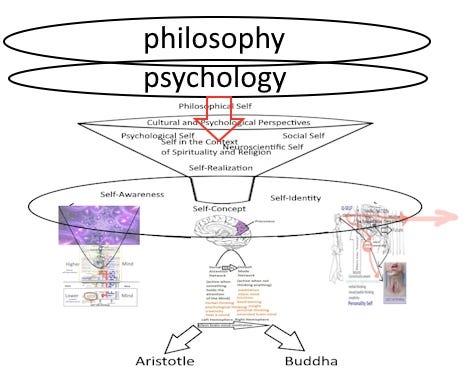
This is the bridge between stillness and how self/identity/personality is generated in the brain-mind.

To understand anything — thought, emotion, fear, desire, memory, identity — we do not analyse it. We do not interpret it. We do not move toward or away.

We simply drop the experience into awareness and watch what the mind does.

A sound appears. A memory appears. A feeling rises.

If there is no movement, the experience dissolves back into stillness. If there is movement, the self forms. The self is created only when the centre separates from itself and generates the self-bridge. Creates identity, personality.

The self is not something you are. It is the movement that begins when awareness leans.

This leaning can be forward, grasping. Or backwards, resisting. Or sideways, avoiding.

But the movement is the same. The leaning is the beginning of identity.

When you watch the leaning, the moment it begins, the self has no ground to form. Awareness remains whole, untouched.

Drop any experience into stillness and simply observe:

Does the mind lean? Does it try to hold? Does it try to reject? Does it try to become something?

The meaning of anything is revealed by how the mind moves when it meets the experience.

Nothing else is needed.

This is how you understand thought. This is how you understand emotion. This is how you understand identity.

Not by thinking about them. By seeing the movement that creates them.

Stillness is the ground. Movement is the self.

In stillness, you receive information from the “intelligence” of the Universe.

In movement, the self is thinking, referencing memory.

When movement is seen clearly, the self dissolves. When the self dissolves, stillness remains.

And from stillness, intelligence moves without effort.

When intelligence moves without a self, it is no longer personal. It is not “my” insight or “my” understanding — it is the same ordering principle that shapes galaxies, particles, nervous systems, thought, and life itself. This is what some have called superintelligence: not a higher intellect, but intelligence freed from the constraint of identity. When the mind is still, it becomes open to the same pattern that organises the universe. Insight does not come from the self. It comes when the self is absent. The Truth is when the self is not, when there is no movement in the mind. When the self is at play, it is movement. Thought is movement. Accessing memory is movement.

The universe forms itself in the same way. The wave rises from the ocean and returns to it. The galaxy expands and contracts. The breath moves in and out.

You are not separate from this. You are this when there is silence in the mind.

To see truth, you do not reach. You stop reaching.

You remain at the centre. You watch the movement. You recognise that the self was only movement all along.

The self is the bridge.

From here, the next step reveals itself.

We now begin to watch how the self forms in real time.

And in the seeing, it begins to loosen.

And in the loosening, the centre becomes natural.

And in the centre, the universe speaks directly.

Not in words. In direct knowing.

Direct perception from the source.

Press enter or click to view image in full size

With stillness in Brain-Mind there is no thinking or memory — only direct perception, a direct “sense of knowing” with no thinking. Only direct receiving from the “intelligence” of the Universe as a repository.
Stillness In Mind

Related Images:

The Centre and Its Movement That Becomes the Self

We begin at the exact point where experience forms itself.

Before identity. Before thought. Before memory. Before the idea of “me.”

There is awareness. Still, whole, unbroken.

From this stillness, the world appears — sound, sensation, colour, breath. There is no separation yet. No one to receive it. No one to be moved by it. Only the happening of life.

Then something subtle occurs.

A movement.

A leaning.

The mind reaches — toward or away. And in that movement, the sense of “I” is born.

The self is not something you are.

The self is something the mind does.

The movement that becomes the self is subtle. It begins so quickly and so quietly that most people live their entire lives without ever noticing it. A sensation arises — the breath, the hum of a room, the memory of yesterday — and instead of simply being aware of it, the mind reaches. It leans. It moves to relate, interpret, categorise, secure, or resist. This leaning is not something a person decides. It is automatic. It is the momentum of identity beginning to form.

In this movement, the sense of “I” appears. Not as a thing, not as a solid presence, but as the activity of holding. The self is the holding. The self is the gripping of experience. The self is the momentum that tries to stabilise what is always changing. And because the world never stops changing, the holding never ends.

This is why the self feels continuous — because the leaning never stops.

But if the movement is seen — clearly, directly, without judgement — something else happens. The leaning loses its force. The compulsion loosens. The mind no longer moves automatically. Awareness rests in itself. The movement dissolves in the seeing of it.

And when the movement dissolves, the self dissolves with it.

Not as a loss. Not as a death. Not as a disappearance.

But as a return.

Awareness remains — unbroken, unpulled, unmoved. The centre was always here, but it was covered by the movement that tried to become someone. When the movement ends, the centre is revealed — not gained, not created, but uncovered.

The self does not return to the centre. The centre remains when the self ends.

This is the beginning of seeing without the one who sees.

When the movement stops, there is no inner voice. No commentary, no effort, no one describing experience to themselves. Awareness remains, but without a watcher. Seeing happens, but there is no one who is seeing.

This recognition is immediate. It does not come from thought. It does not come from memory. It does not come from understanding. It is known the moment it is experienced.

You realise:

The mind is silent, yet I am still here. There is awareness, but no one holding it. There is perception, but no centre from which it is perceived.

This is the centre. Not a state. Not a practice. Not a place to reach. But the ground that is always here when the movement ends.

It is not something gained. It is what remains when nothing is being done.

But movement will return. It always does. A sound will be loud. A thought will be charged. A memory will appear with weight. And the mind will begin to lean again. This is not a failure. It is simply the natural rhythm of being alive.

The difference now is that the leaning can be seen. The moment the movement begins, it is recognised as movement — not as “me”, not as truth, not as identity. The self begins to form, but it is transparent. It has no weight. It does not need to be suppressed or corrected. It can appear without becoming the centre.

This is how the centre remains while the world moves.

The self returns to do what it was always meant to do — to navigate the ordinary tasks of living. To speak when speaking is needed. To act when action is needed. To organise, to respond, to function. But it no longer claims to be the one who exists. It no longer claims to be the centre.

The centre does not replace the self. The centre holds the self gently, the way stillness holds sound.

Movement arises. Movement dissolves. Awareness remains.

This is the complete cycle.

Movement rises from the centre and returns to it, the way a wave rises from the sea and falls back into it. The self is simply the arc of this movement — the curve of attention as it leans outward, forms identity, and then dissolves back into stillness. Nothing needs to be controlled or prevented. The mind does not have to stay in the centre. It only needs to see the movement as movement. When the rising and returning are both seen clearly, the centre is never lost — because it was never left.

This movement is not only personal. The universe unfolded the same way — stillness, then movement, then form.

As the self leans out of stillness, the cosmos once leaned out of equilibrium. The same pattern repeats: stillness, movement, form, and return. Seeing it here is to see it everywhere.

The Movement Of Self

Related Images: